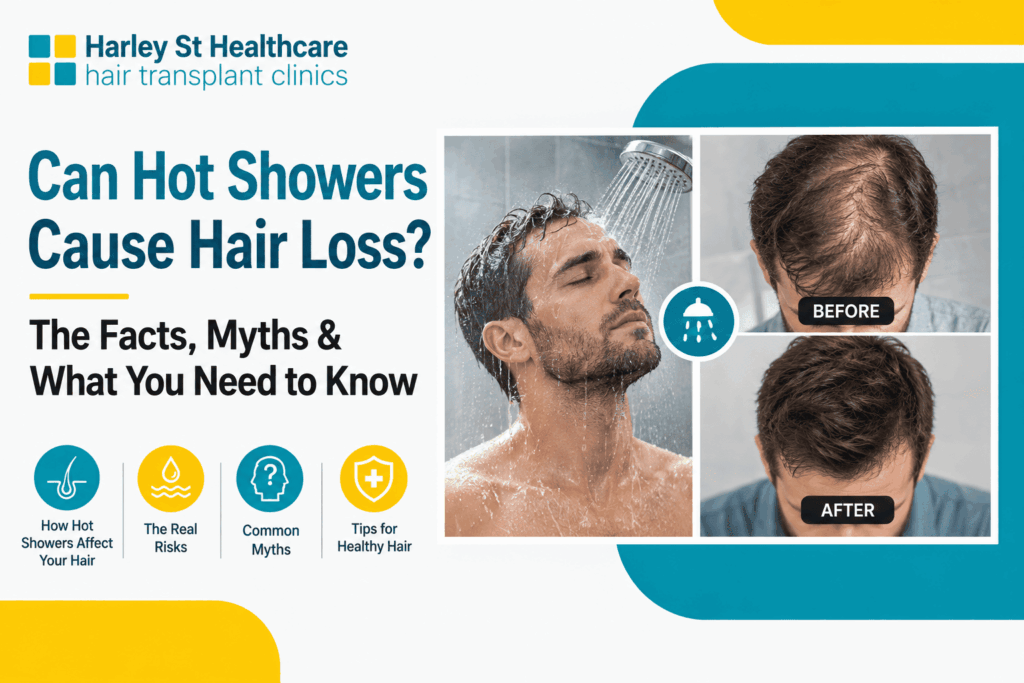
Hot showers can feel relaxing, particularly during cold weather, but you may have wondered whether the heat could be contributing to hair loss. If you notice more hair than usual in the shower drain, it is understandable to question whether the temperature of the water is responsible.
Table of Content
ToggleSo, do hot showers cause hair loss? Generally, hot water is not considered a direct cause of permanent hair loss. However, very hot water can affect the hair shaft and scalp, potentially causing dryness, irritation and increased breakage. This can make your hair appear thinner or less healthy.
It is also important to distinguish hair breakage from hair loss. True hair loss usually involves changes in the hair-growth cycle or the hair follicle and can have causes such as genetics, hormonal changes, illness, stress or nutritional problems.
Do Hot Showers Cause Hair Loss?
For most people, hot showers do not directly cause permanent hair loss.
The temperature of shower water does not normally damage the hair follicle in a way that causes permanent baldness. However, consistently washing your hair with very hot water may remove some of the natural oils that help protect the scalp and hair.
This can leave the hair feeling:
- Dry or rough
- Brittle
- Frizzy
- More prone to tangling
- Easier to break
If hair becomes fragile and breaks more easily, you may notice shorter or broken hairs and reduced-looking hair density.
Therefore, while hair loss from hot water is not generally considered a direct cause of permanent follicle damage, very hot showers may contribute to hair damage and breakage.
Can Hot Water Cause Hair Loss?
If you are asking, “can hot water cause hair loss?”, the answer depends on what you mean by hair loss.
Very hot water is more likely to affect the hair shaft and scalp than the follicle itself. Repeated exposure may contribute to dryness and irritation, while fragile hair can be more susceptible to breakage.
However, if you are experiencing significant shedding from the root, hot water is unlikely to be the main explanation.
Hair that suddenly starts falling out in larger amounts may instead be associated with factors such as:
- Hereditary hair loss
- Stress or illness
- Hormonal changes
- Nutritional deficiencies
- Certain medications
- Alopecia areata
- Significant weight loss
- Scalp conditions
If your shedding has noticeably increased, it is therefore worth considering the wider picture rather than automatically blaming your shower temperature.
Can Hot Water Damage Hair?
Yes. Hot water can damage hair, particularly when exposure is frequent or the water is extremely hot.
Hair naturally has a protective outer layer called the cuticle. Excessive heat and repeated exposure to harsh conditions can contribute to cuticle damage, making the hair feel rougher and more vulnerable to breakage.
Hot water may also strip away some of the scalp’s natural oils. These oils help maintain moisture and provide some protection to the hair shaft.
As a result, you may notice:
- Increased dryness
- Split ends
- Frizz
- Hair breakage
- Increased tangling
- A rougher hair texture
This does not necessarily mean the hair follicles are being permanently damaged. Hair breakage and follicular hair loss are different problems.
Can Hot Water Make Your Hair Fall Out?
The question “can hot water make your hair fall out?” is common, especially when someone notices loose hairs after washing.
Some hair shedding during a shower is completely normal. Hair naturally goes through growth, resting and shedding phases, so loose hairs can become more noticeable when washing or brushing.
Hot water itself is unlikely to suddenly cause large amounts of hair to shed from healthy follicles.
If you are consistently finding substantially more hair in the shower, on your pillow or on your brush, another underlying cause may be responsible.
For example, telogen effluvium can cause increased shedding several weeks or months after a significant physical or emotional stressor. Illness, surgery, major stress, childbirth and substantial weight changes can all be potential triggers.
Can Hot Showers Cause Hair Loss in Men and Women?
The same general principle applies to both men and women: hot showers are not usually considered a direct cause of permanent hair loss.
However, men and women can experience different patterns of underlying hair loss.
Men commonly develop hereditary hair loss around the hairline and crown, while women may notice diffuse thinning or a widening parting.
If someone with hereditary hair loss takes very hot showers, the shower itself is unlikely to be responsible for the underlying pattern. The genetic hair-loss process is a separate issue.
This distinction matters because changing your shower temperature may improve hair and scalp condition, but it will not necessarily stop progressive genetic hair loss.
Hair Loss Hot Water: How Can You Protect Your Hair?
You do not need to stop taking showers to protect your hair. A few simple changes can reduce unnecessary dryness and damage.
Use Warm Rather Than Very Hot Water
Try using comfortably warm water rather than water that feels excessively hot on your scalp or skin.
Avoid Prolonged Hot Showers
Spending a long time under very hot water may increase dryness. Keeping showers reasonably short can help minimise unnecessary exposure.
Be Gentle When Washing
Use your fingertips rather than aggressively scratching the scalp. A gentle massage can help distribute shampoo without unnecessary friction.
Handle Wet Hair Carefully
Wet hair can be more vulnerable to stretching and breakage. Avoid vigorous rubbing with a towel and be gentle when brushing or detangling.
Limit Other Sources of Heat
Hair dryers, straighteners and curling irons can also contribute to hair damage when used excessively or at high temperatures. Allowing your hair to dry naturally when practical and using appropriate heat protection can help reduce damage.
When Is Hair Loss a Sign of Something Else?
If you are experiencing genuine hair loss, changing the temperature of your shower may not address the underlying cause.
Consider speaking with a GP or qualified hair-loss professional if you notice:
- Sudden or significant shedding
- Rapidly worsening thinning
- A receding hairline
- A widening parting
- Clearly defined bald patches
- Increasing scalp visibility
- Scalp itching, pain, redness or scaling
- Hair loss affecting your eyebrows or other areas
A professional assessment can help distinguish between temporary shedding, hair breakage, hereditary hair loss and other conditions.
Conclusion
So, do hot showers cause hair loss? Generally, no. Hot water is not considered a direct cause of permanent hair loss, but very hot showers can contribute to dryness, scalp irritation and hair-shaft damage, potentially increasing breakage.
If you are noticing significantly more shedding, a receding hairline, a widening part or progressive thinning, the cause may be unrelated to your shower temperature. Genetics, hormonal changes, stress, illness, nutritional factors and scalp conditions can all contribute to hair loss.
Using comfortably warm water, treating your hair gently and limiting excessive heat can help protect the hair you have. However, persistent or unexplained hair loss should be assessed professionally so that the underlying cause can be identified.
FAQs
Hot showers are not generally considered a direct cause of permanent hair loss. However, very hot water can contribute to dryness, irritation and hair breakage.
Hot water is unlikely to directly damage healthy hair follicles and cause permanent hair loss. Excessive heat can, however, contribute to hair-shaft damage and breakage.
Yes. Very hot water can strip natural oils from the hair and scalp, potentially leaving hair dry, brittle and more prone to breakage.
Hot water does not usually cause significant shedding from the hair follicle. If you are experiencing increased hair fall, another underlying factor may be responsible.
You do not necessarily need cold water. Using comfortably warm rather than very hot water is generally a practical approach for reducing unnecessary dryness and irritation.
Some shedding during washing is normal. If you notice a persistent increase in shedding, visible thinning, bald patches or a receding hairline, consider speaking with a GP or qualified hair-loss professional.