Summary
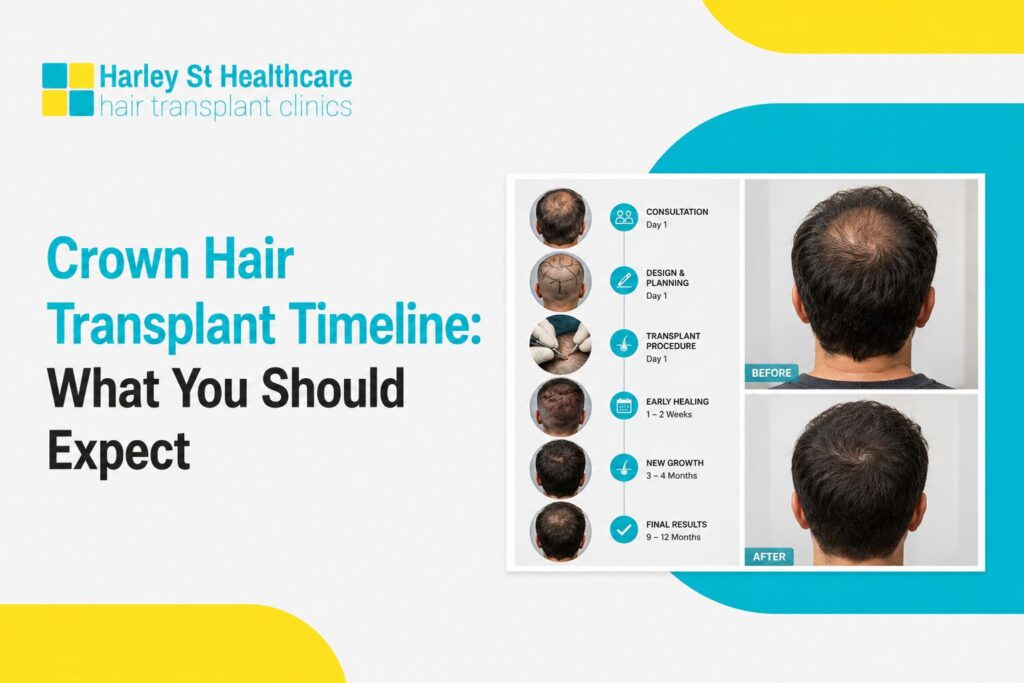
A crown hair transplant can effectively restore thinning or bald areas at the vertex of the scalp, but results usually take longer compared to the hairline. Most patients begin noticing visible growth within 4–6 months, while final crown hair transplant results may take up to 12–15 months due to the unique growth pattern and blood supply in the crown area.
Table of Content
ToggleIntroduction
Hair loss in the crown area is one of the most common concerns among men experiencing male pattern baldness. Unlike frontal hair loss, crown thinning often spreads gradually in a circular pattern, making it harder to conceal over time.
A crown hair transplant is designed specifically to restore density in this region using healthy hair follicles taken from the donor area. While modern techniques like FUE deliver natural-looking results, many patients are surprised that crown hair transplant recovery and growth timelines can be slower than other parts of the scalp.
Understanding the full crown hair transplant timeline helps set realistic expectations and allows patients to better track progress after surgery.
What Is a Crown Hair Transplant?
A crown hair transplant is a hair restoration procedure focused on the vertex or crown area of the scalp — the circular region at the back of the head where thinning and bald spots commonly develop.
The procedure involves extracting healthy hair follicles from the donor area and implanting them into the crown using precise angles and placement patterns to recreate the natural swirl of hair growth.
Common Reasons Patients Choose Crown Hair Transplant:
- Visible crown thinning
- Expanding bald spot at the vertex
- Loss of hair density
- Male pattern baldness progression
- Desire for permanent crown hair replacement
Modern FUE hair transplant techniques are commonly used because they leave minimal scarring and allow natural-looking density.
Crown Hair Transplant Timeline
Right After the Hair Transplant Procedure
Immediately after the procedure, the scalp may feel tender and sensitive. Small scabs around the implanted grafts are completely normal.
Patients may also experience:
- Mild redness
- Swelling
- Tightness in the scalp
- Temporary discomfort
This stage is critical for graft survival, so following aftercare instructions carefully is essential.
During the First Week:
- Scabs begin forming
- Swelling gradually reduces
- Donor area starts healing
- Sleeping position precautions are recommended
Most patients can return to normal desk-based work within a few days.
First 2 Months After Crown Hair Transplant
This is often the most emotionally challenging stage because transplanted hairs usually begin shedding. This process is called shock loss and is completely normal.
Many patients worry the transplant has failed during this phase, but the follicles remain healthy beneath the scalp.
What Happens During This Phase:
- Transplanted hairs shed
- Scalp healing continues
- Follicles enter resting phase
- Early invisible growth begins underneath
The crown area may temporarily look similar to how it appeared before surgery.
Crown Hair Transplant After 4 Months
Around month 4, early growth usually becomes visible. New hairs often appear thin, soft, and lighter initially.
This stage marks the beginning of noticeable improvement.
Typical 4-Month Changes:
- Small new hairs emerging
- Early crown coverage improvement
- Reduced visibility of bald spot
- Improved scalp density
Because the crown has a spiral growth pattern, density may still appear uneven at this point.
Crown Hair Transplant Results After 6–8 Months
By this stage, patients usually notice significant cosmetic improvement.
The transplanted hair starts thickening and blending naturally with surrounding hair.
What Most Patients Notice:
- Better crown coverage
- Increased density
- Stronger hair texture
- More natural appearance
- Easier hairstyling
For many patients, this is when confidence noticeably improves.
Final Crown Hair Transplant Results (12–15 Months)
Full crown hair transplant results generally take longer compared to frontal hairline transplants.
Most patients achieve final results between 12 and 15 months, although some continue seeing improvement beyond that.
Final Results Typically Include:
- Mature hair texture
- Fuller crown density
- Natural blending
- Permanent hair growth
- Reduced visibility of thinning
Patience is important because crown hair growth naturally develops more slowly.
Why Does Crown Hair Growth Take Longer?
The crown area is one of the most challenging regions in hair restoration due to several anatomical and growth-related factors.
1. Lower Blood Supply
The crown area generally receives slightly less blood circulation compared to the frontal scalp, which can slow healing and graft growth.
2. Unique Hair Growth Pattern
The crown naturally grows in a swirl or spiral pattern. Recreating this pattern requires precise graft placement and can affect how density appears during early growth stages.
3. Larger Coverage Area
Crown baldness often covers a larger surface area, meaning more grafts are needed to achieve noticeable density.
4. Hair Growth Cycles
Hair follicles grow in cycles, and crown follicles may remain in the resting phase longer before producing visible growth.
5. Individual Healing Differences
Factors like:
- Age
- Smoking
- Nutrition
- Stress
- Overall scalp health
can influence how quickly transplanted hair grows.
Crown Hair Transplant Before and After: What to Expect
Most patients experience gradual transformation rather than instant results.
Before Treatment:
- Visible crown thinning
- Bald spot expansion
- Reduced confidence
- Difficulty styling hair
After Full Recovery:
- Improved crown density
- Natural-looking coverage
- Better hair styling options
- Long-term hair restoration
Realistic expectations are essential because the goal is usually improved density and natural appearance — not necessarily teenage-level thickness.
Crown Hair Transplant Success Rate
Modern FUE crown hair transplant procedures generally have a high success rate when performed by experienced specialists.
Success depends on:
- Surgeon expertise
- Donor hair quality
- Graft handling
- Scalp condition
- Proper aftercare
In suitable candidates, graft survival rates can exceed 90%.
Crown Thinning Treatment Alternatives
Not every patient with crown thinning requires immediate surgery.
Early-stage crown thinning treatment options may include:
PRP Therapy
PRP injections help stimulate weak hair follicles and improve hair density.
Finasteride
Helps slow male pattern baldness progression by reducing DHT levels.
Minoxidil
Supports hair growth and improves follicle activity.
Combination Treatments
Many clinics combine medications, PRP, and transplant procedures for enhanced long-term results.
Is Crown Hair Transplant Permanent?
Yes, transplanted hair follicles are typically permanent because they are taken from DHT-resistant donor areas.
Once fully established, transplanted crown hair continues growing naturally for years.
However, existing non-transplanted hair may continue thinning over time, which is why maintenance treatments are sometimes recommended.
Why Choose Hair Transplant Clinics for Crown Hair Restoration?
If you are considering a crown hair transplant or exploring crown thinning treatment options, Hair Transplant Clinics offers personalised treatment plans designed around your level of hair loss and long-term goals.
Our team focuses on creating natural crown density using advanced hair restoration techniques and careful graft placement for realistic-looking results.
What You Can Expect:
- Personalised consultation and treatment planning
- Advanced FUE hair transplant techniques
- Natural crown design and graft placement
- Clinically guided procedures
- Ongoing aftercare support
Whether you are dealing with early crown thinning or advanced hair loss, Hair Transplant Clinics can help you explore the most suitable treatment options.
Final Thoughts
A crown hair transplant can provide long-lasting and natural-looking improvement for patients struggling with crown baldness and thinning.
However, crown hair restoration requires patience. Unlike the hairline, the crown area often takes longer to heal and show full density due to its unique growth pattern and blood supply.
Understanding the crown hair transplant timeline helps set realistic expectations and allows patients to better appreciate the gradual transformation process.
With proper aftercare, realistic expectations, and expert treatment planning, crown hair replacement can significantly improve both appearance and confidence over the long term.