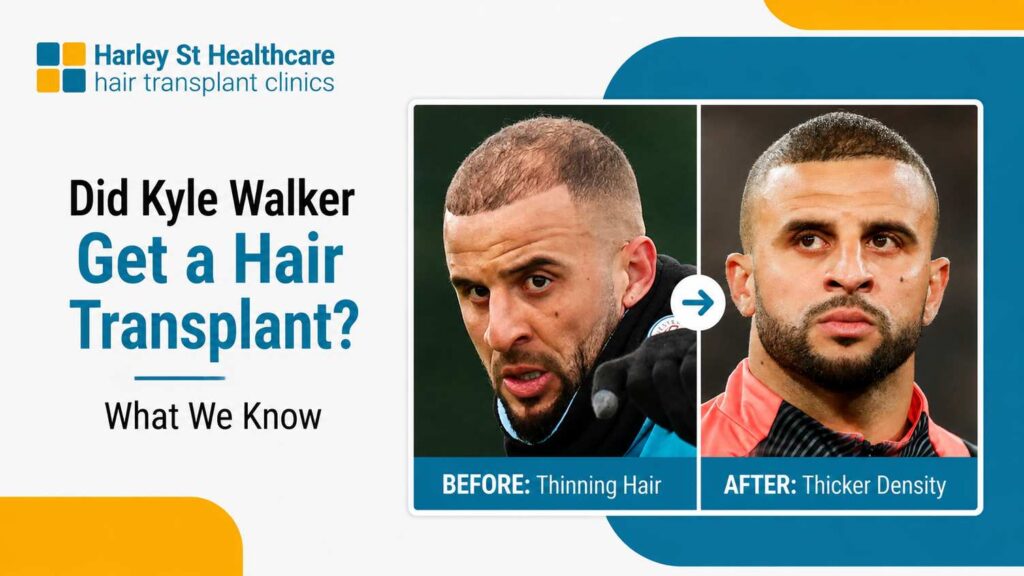
Summary
Kyle Walker’s changing hairline has attracted speculation about whether the England footballer has undergone a hair transplant. According to reported information, Walker attended a hair-transplant consultation where FUE hair transplantation was discussed, with an estimated requirement of approximately 1,500–1,800 grafts.
However, a consultation and treatment recommendation do not, by themselves, confirm that surgery took place.
This distinction is important when discussing a public figure’s appearance. Photographs can show that someone’s hair looks different over time, but they cannot reliably establish whether a hair transplant was performed.
Table of Content
ToggleDid Kyle Walker Get a Hair Transplant?
There is reported evidence that Kyle Walker attended a hair-transplant consultation where FUE treatment was discussed. However, this does not definitively confirm that he underwent the procedure.
According to the available information, Walker attended a consultation to discuss his hair and potential restoration options. FUE hair transplantation was considered, with an estimated requirement of around 1,500–1,800 grafts.
It is important to distinguish between a consultation and a completed hair transplant.
A consultation means that treatment options were assessed and discussed. It does not necessarily mean that the patient went ahead with surgery.
Photographs of a celebrity’s hair also cannot reliably confirm that a transplant has taken place. Changes in hair appearance can be influenced by several factors, including:
- Hairstyle and hair length
- Lighting and camera angle
- Hair texture and density
- Styling products
- Natural changes in hair growth
- Progression of hair loss
- Non-surgical hair-loss treatments
- Hair transplantation
Therefore, while Kyle Walker’s hairline has changed over the years, it would be inappropriate to state that he definitely had a hair transplant without reliable confirmation that the procedure was completed.
Kyle Walker’s Hairline: What Has Changed?
Kyle Walker has spent much of his adult life in the public eye, meaning photographs of his appearance are available from different stages of his football career.
Earlier photographs appear to show a relatively full frontal hairline, while later images have led to speculation about recession and changes in hair density.
However, comparing photographs from different years is not the same as receiving a clinical assessment.
Hair can look significantly different depending on:
- Hair length
- Hairstyle
- Curl or texture
- Lighting
- Camera quality
- Hair products
- Styling techniques
- Photograph angle
This is particularly relevant when discussing celebrity hair loss. A visible change may lead to speculation, but it does not establish the cause or confirm a specific treatment.
Kyle Walker’s Earlier Hairline
Photographs from earlier periods of Kyle Walker’s career are often used when people discuss how his hairline may have changed over time.
Some images appear to show a fuller or lower-looking hairline, while later photographs have prompted discussion about recession or reduced density.
However, it is important not to automatically label an earlier photograph as a “before” image. Doing so could imply that a confirmed hair transplant followed it, when that has not been established.
The more reliable information is that Walker reportedly attended a consultation where FUE hair transplantation was discussed.
What Happened During Kyle Walker’s Hair Transplant Consultation?
According to the reported information, Kyle Walker attended a consultation to discuss his hair and potential restoration options.
During the consultation, FUE hair transplantation was discussed, with an estimated requirement of approximately 1,500–1,800 grafts.
A proper hair-transplant consultation involves more than simply looking at the hairline.
A clinician may assess:
- The pattern and extent of hair loss
- Existing hair density
- Donor-area availability
- Hair calibre and characteristics
- The size of the potential treatment area
- The condition of the scalp
- The likelihood of further hair loss
- Long-term treatment requirements
This is why a graft estimate should always be viewed as an individual treatment estimate, rather than a standard recommendation for anyone with a similar-looking hairline.
Hair-transplant planning is generally based on the patient’s existing hair, donor supply, treatment goals and longer-term hair-loss pattern.
Why Was FUE Considered for Kyle Walker?
FUE, or Follicular Unit Extraction, is a hair-transplant technique in which individual follicular units are removed from a suitable donor area and transplanted into areas affected by hair loss or thinning.
Unlike FUT, which involves removing a strip of scalp, FUE involves individual extraction of follicular units. Although FUE is less invasive than strip harvesting, it is still a surgical procedure and can leave small marks in the donor area.
Whether FUE is appropriate depends on factors such as:
- Donor hair density
- Hair-loss pattern
- Recipient area
- Hair characteristics
- Existing native hair
- Future hair-loss risk
- Individual treatment goals
There is therefore no single hair-transplant technique that is automatically suitable for everyone.
How Many Grafts Was Kyle Walker Reportedly Considered For?
The reported consultation discussed approximately 1,500–1,800 grafts.
It is important to understand that a graft is not the same as an individual hair.
A follicular-unit graft can contain one or several hairs. Therefore, a plan involving 1,500 grafts does not mean that exactly 1,500 individual hairs would be transplanted.
The required number of grafts depends on the individual treatment area, existing hair density, donor supply and the amount of coverage being considered.
Is 1,500–1,800 Grafts a Large Hair Transplant?
Not necessarily.
A graft number only makes sense when considered alongside the size of the treatment area and the patient’s existing hair.
For example, someone with limited frontal recession may require a different number of grafts from someone with more extensive thinning, even if their hairlines initially appear similar.
Other factors, including hair calibre and donor density, can also affect the treatment plan.
This is why another person’s graft number should never be used as a personal treatment target.
How Long Until Hair Transplant Grafts Are Secure?
Hair-transplant grafts require an initial healing period after surgery, but the exact timeline varies between patients and procedures.
After FUE or another hair-transplant procedure, the newly placed grafts need time to settle and heal within the recipient area. Patients should follow the specific aftercare instructions provided by their surgical team.
It is also important to understand that graft healing and visible hair growth are two different stages.
A graft can be healing normally even though the transplanted hair is not yet visibly growing.
Hair growth following transplantation takes time, and patients should not expect the final cosmetic result immediately after surgery. The recovery process can include early healing, shedding and gradual new growth, which should be explained as part of the treatment plan.
Your surgeon or clinical team should provide personalised information about aftercare and recovery based on the procedure performed.
Could Kyle Walker Have Used DHI Instead?
DHI is another hair-restoration approach that people may consider when researching different transplant techniques.
However, there is no reliable basis for stating that Kyle Walker underwent DHI.
The reported consultation specifically discusses FUE, rather than confirming DHI treatment.
More broadly, treatment outcomes can be influenced by factors including:
- Patient suitability
- Donor hair quality
- Hair-loss pattern
- Surgical planning
- Graft handling
- Recipient-site design
- Implantation technique
- Aftercare
- Future progression of hair loss
The important point is that a particular technique should not be assumed to have been used simply because the final appearance looks a certain way.
Does a Hair Transplant Stop Hair Loss?
No.
A hair transplant redistributes suitable hair follicles but does not automatically stop future hair loss in untreated native hair.
This is an important consideration when planning hair restoration.
A patient may have transplanted follicles in one area while naturally occurring hair loss continues elsewhere. The hair behind or around a transplanted area can therefore change over time.
This is why a good treatment plan should consider both the patient’s current appearance and the possibility of future hair loss.
Long-term planning can be particularly important when deciding how to design and position a new hairline.
What Can Kyle Walker’s Hair Journey Tell Us About Hair Loss?
The main lesson is that appearance alone cannot reliably tell you whether someone has had a hair transplant.
Even when photographs appear to show a significant change, there may be several possible explanations.
For someone experiencing hair loss themselves, a professional assessment should consider:
- What type of hair loss is present?
- How extensive is the thinning or recession?
- Is the hair loss stable or continuing to progress?
- Is there sufficient donor hair?
- Which treatment options may be appropriate?
- How should treatment be planned for the longer term?
This is much more reliable than comparing your own hairline with photographs of a celebrity.
How Do Hair Transplants Create Natural-Looking Results?
A natural-looking hair transplant is not simply about placing as many grafts as possible.
Hairline design, graft placement and long-term planning all play important roles in the overall appearance.
At the frontal hairline, the arrangement of grafts needs to create an appropriate transition between the forehead and the existing hair.
The treatment plan may take into account:
- Age
- Facial proportions
- Existing hairline
- Hair calibre
- Hair characteristics
- Donor availability
- Existing native hair
- Potential future hair loss
The aim should be to create a result that is appropriate for the individual rather than simply attempting to recreate the hairline they had at a younger age.
Could Kyle Walker’s Hair Changes Have Another Explanation?
Yes.
Changes in hair appearance can occur for many reasons, and it would not be appropriate to diagnose a specific condition in a public figure without a clinical assessment.
Changes in apparent density may be influenced by factors such as:
- Natural progression of hair loss
- Temporary shedding
- Hairstyle changes
- Hair length
- Styling products
- Hair-loss treatments
- Photography and lighting
For this reason, claims that Kyle Walker “definitely” had a hair transplant should be treated cautiously unless supported by reliable confirmation.
Did Kyle Walker Actually Go Ahead With the Hair Transplant?
The available information indicates that a consultation took place in which FUE hair transplantation and an estimated 1,500–1,800 grafts were discussed. It does not, by itself, confirm that the procedure was subsequently completed.
This distinction is particularly important when discussing medical or cosmetic procedures involving public figures.
A consultation means that treatment options were considered and discussed. It does not necessarily mean that surgery went ahead.
Therefore, the most accurate answer is:
Kyle Walker has been reported to have attended a hair-transplant consultation where FUE treatment was considered, but the consultation alone should not be presented as definitive proof that he underwent a hair transplant.
What Can Patients Learn From Kyle Walker’s Case?
Perhaps the most useful takeaway is that hair-transplant treatment is individual and graft numbers are not one-size-fits-all.
Two people can have apparently similar hairlines but require very different treatment plans.
One patient may have strong donor density and limited frontal recession. Another may have more extensive thinning, different hair characteristics or a greater risk of future hair loss.
A proper assessment should therefore consider the entire scalp and the patient’s longer-term hair-loss pattern, rather than focusing only on the visible hairline.
Thinking About a Hair Transplant?
If you’re experiencing hair thinning or recession, an individual assessment is more useful than comparing your hair with a celebrity’s photographs.
At Harley Street Hair Transplants Clinic, a consultation can help assess your hair-loss pattern, donor area and potential treatment options so that any recommendation is based on your individual circumstances.
Your hair-loss journey is personal. Your treatment plan should be too.
Conclusion
Kyle Walker’s hairline has generated considerable speculation, but the available information needs to be interpreted carefully.
A reported consultation indicates that FUE hair transplantation was discussed, with an estimated 1,500–1,800 grafts considered. However, a consultation and graft estimate should not automatically be presented as proof that Walker underwent the procedure.
For anyone experiencing hair loss themselves, the more useful lesson is that hair restoration should begin with proper assessment and realistic long-term planning.
Donor availability, existing hair, hair-loss progression and individual characteristics all influence whether a hair transplant may be appropriate.
Celebrity photographs can be interesting to look at, but they cannot replace a professional assessment of your own hair loss.
FAQs
There is reported evidence that Kyle Walker attended a hair-transplant consultation where FUE was discussed. However, the consultation and graft estimate should not be treated as definitive proof that he subsequently underwent surgery.
The reported consultation discussed approximately 1,500–1,800 grafts. This was an individual estimate and should not be used to predict how many grafts another patient would require.
The reported consultation discussed FUE hair transplantation. There is no reliable basis in the information reviewed here to state that Kyle Walker underwent DHI.
FUE refers to the extraction of individual follicular units from the donor area. DHI is generally used to describe a particular method of implanting extracted follicles. The appropriate approach depends on the patient's individual circumstances and surgical plan.
Transplanted grafts need an initial healing period after surgery, but the exact recovery timeline varies between patients. Graft healing and visible hair growth are separate stages, with new growth developing gradually over the following months.
It may be appropriate for some treatment areas, but there is no universal graft number that is right for everyone. Requirements depend on the treatment area, existing density, donor supply, hair characteristics and treatment goals.
No. A hair transplant redistributes suitable follicles but does not necessarily prevent untreated native hair from thinning in the future. Long-term planning is therefore an important part of hair-transplant assessment.
Not reliably. Hair length, styling, lighting, camera angle and hair products can all change how hair looks. Clinical assessment or reliable first-hand information is more useful than photographic speculation.
Not necessarily. Graft requirements are individual and depend on factors such as the size of the treatment area, existing hair density, donor availability, hair characteristics and the expected progression of hair loss.