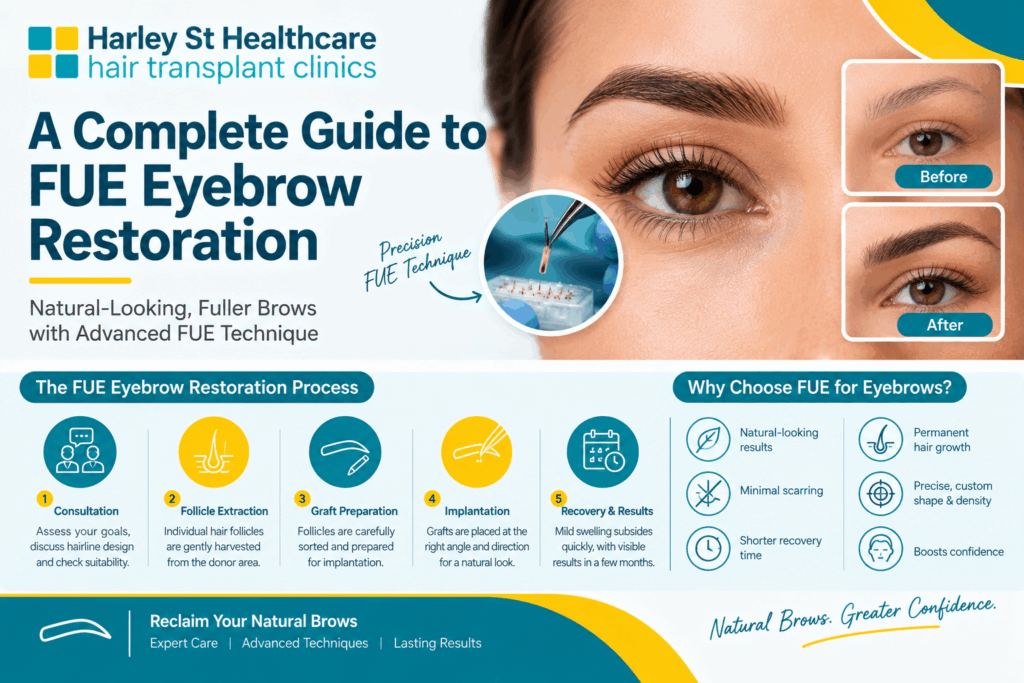
An eyebrow transplant is a hair restoration procedure designed to improve thin, sparse or uneven eyebrows by transferring healthy hair follicles into the eyebrow area. FUE eyebrow transplant techniques involve extracting individual follicles from a donor area and implanting them at carefully planned angles to recreate a natural-looking eyebrow shape. Understanding the procedure, recovery process, suitability and expected results can help patients make an informed decision about eyebrow restoration.
Table of Content
ToggleWhat Is FUE Eyebrow Restoration?
FUE, or Follicular Unit Extraction, is a hair transplant technique in which individual hair follicles are removed from a donor area rather than harvested as a strip of skin.
During an eyebrow hair transplant, suitable follicles are implanted into areas where eyebrow hair is missing or lacks density. The objective is to improve coverage while preserving the natural direction, angle and shape of the eyebrows.
People may consider eyebrow restoration because of naturally thin eyebrows, repeated over-plucking, ageing, scarring or certain forms of hair loss. However, the underlying cause should be assessed before treatment, particularly when eyebrow thinning develops suddenly or progressively.
Who Can Benefit from an Eyebrow Transplant?
An eyebrow transplant may be suitable for individuals who want to improve eyebrow density or restore hair in specific areas.
Common reasons for considering treatment include:
- Naturally sparse or thin eyebrows.
- Uneven growth between the two eyebrows.
- Hair loss following repeated plucking.
- Gaps caused by injuries or certain scars.
- Eyebrow thinning associated with ageing.
- Incomplete eyebrow growth due to genetic factors.
Suitability depends on the availability of healthy donor hair, the condition of the recipient area and the reason for hair loss. People with certain active skin conditions or untreated causes of hair loss may need further assessment before proceeding.
A consultation can help establish whether transplantation is appropriate or whether another treatment approach should be considered.
How Does the Eyebrow Transplant Procedure Work?
The eyebrow transplant procedure requires detailed planning because eyebrow hairs grow at shallow angles and change direction across different parts of the brow. The process generally involves several stages.
1. Eyebrow design and consultation
The clinician assesses existing eyebrow hair, facial proportions and the patient’s desired shape. A proposed outline helps guide the treatment plan, including the areas where additional density may be needed.
2. Donor hair extraction
A suitable donor area, often on the scalp, is selected. Individual follicles are extracted using the FUE technique. Donor hair is chosen with consideration for its characteristics and suitability for the eyebrow area.
3. Graft preparation
The extracted follicles are prepared for implantation. Careful handling helps preserve the grafts before placement.
4. Implantation into the eyebrows
Small recipient sites are prepared in the planned eyebrow area. Each follicle is positioned with attention to angle, direction, spacing and density.
This stage is particularly important because incorrectly angled hairs may grow outward or stand up unnaturally rather than following the contours of the eyebrow.
Why Does Hair Direction Matter in Eyebrow Transplantation?
The appearance of an eyebrow depends on more than the number of hairs present. Natural eyebrows have different growth directions across the inner brow, arch and tail.
During eyebrow transplantation, the placement of individual follicles should account for these variations. Poorly planned angles or excessive density can make the results appear less natural.
A carefully designed procedure considers:
- The direction in which each section of eyebrow hair grows.
- The angle at which follicles enter the skin.
- The spacing between grafts.
- The balance between both eyebrows.
- The shape that complements the patient’s facial features.
The aim is to create a natural-looking result rather than simply implanting as many follicles as possible.
What Is Recovery Like After an Eyebrow Hair Transplant?
Recovery varies between individuals. Mild redness, swelling, tenderness and small scabs may develop around the treated area during the initial healing period.
Patients should follow their clinician’s aftercare instructions carefully. These may include guidance on cleaning the area, avoiding unnecessary contact with the grafts and protecting the treated skin while it heals.
Some transplanted hairs may shed during the weeks following the procedure. This is often a normal part of the hair-growth cycle and does not necessarily mean the transplant has failed.
New growth takes time, so the appearance immediately after surgery should not be considered the final result.
When Can You Expect to See Results?
Eyebrow restoration is a gradual process. Following the initial healing and shedding phases, new hair growth develops progressively over the following months. The exact timeline differs between patients.
The eventual appearance may depend on:
- The number and quality of implanted follicles.
- Donor hair characteristics.
- The technique used during implantation.
- Individual healing and hair-growth cycles.
- Compliance with aftercare advice.
- The underlying reason for eyebrow hair loss.
Results cannot be guaranteed, and the final density may differ from the patient’s initial expectations. A clinician can explain the likely outcome based on the individual’s circumstances.
Will Transplanted Eyebrow Hair Need Maintenance?
Yes, transplanted hairs may require regular grooming. When scalp hair is used as the donor source, it may retain some of its original growth characteristics, including a tendency to grow longer than natural eyebrow hair.
Patients may need to trim the hairs periodically to maintain their preferred shape and length. The frequency of maintenance varies according to individual hair growth.
It is also important to understand that an eyebrow transplant does not prevent every possible future cause of eyebrow hair loss. Any underlying condition may need separate treatment.
What Risks Should You Consider?
As with other surgical procedures, an eyebrow transplant carries potential risks. These may include temporary swelling, bleeding, infection, scarring, poor graft growth, asymmetry or an unnatural hair direction.
The donor area may also experience temporary discomfort or small scars. Individual outcomes depend on several factors, including the surgical technique and the patient’s healing response.
Discussing these risks during consultation helps ensure that the decision is based on realistic expectations rather than appearance alone.
Planning Eyebrow Restoration at Hair Transplant Clinic
At Hair Transplant Clinic, an eyebrow restoration consultation can help assess existing eyebrow density, donor hair availability and the patient’s desired outcome. The suitability of an FUE eyebrow transplant depends on individual factors, including the cause of hair loss and the condition of the recipient area.
A personalised plan should consider eyebrow shape, natural hair direction, realistic density and ongoing maintenance requirements. These details help patients understand what treatment may achieve and what limitations to expect.
Conclusion
An FUE eyebrow transplant can be a long-term option for people who want to improve sparse, uneven or incomplete eyebrows. The procedure involves extracting individual follicles and implanting them into carefully planned areas to create a more balanced appearance.
Successful eyebrow restoration depends on appropriate patient selection, donor hair quality, precise follicle placement and realistic expectations. Because transplanted hairs may grow differently from natural eyebrow hair, ongoing trimming may also be necessary.
A professional consultation is the best way to understand whether eyebrow transplantation is suitable and to discuss its potential benefits, risks and recovery requirements.
Frequently Asked Questions
Transplanted follicles can provide long-term hair growth, although individual results vary. The hairs may require regular trimming, and the procedure does not prevent other causes of eyebrow hair loss.
A natural-looking result depends on careful eyebrow design, suitable donor hair and precise placement of follicles at appropriate angles and directions. Results vary between individuals.
The procedure is generally performed under local anaesthesia, which helps minimise discomfort during treatment. Some tenderness or swelling may occur afterwards.
Transplanted hairs may shed temporarily after the procedure. This can be part of the normal hair-growth cycle, and new growth may develop later.
People with insufficient donor hair, certain active skin conditions or untreated causes of eyebrow hair loss may not be suitable immediately. A clinician should assess the cause of hair loss and the condition of the treatment area before recommending surgery.