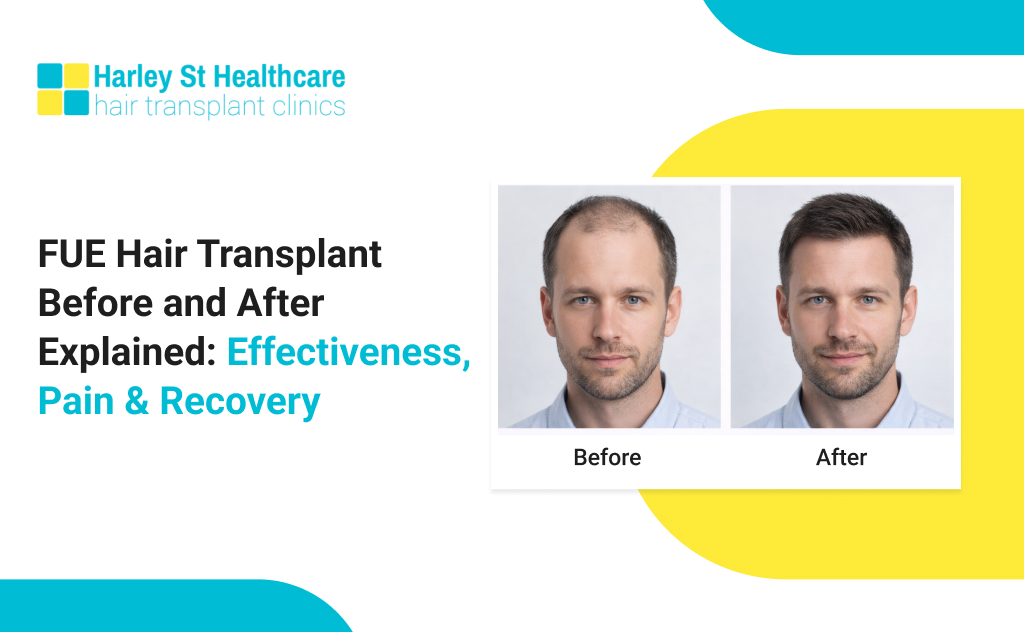
A FUE (Follicular Unit Extraction) hair transplant may reduce the time it takes to increase hair density and look, but the outcome will not be immediate. The visible changes start to appear in the 3-6 months period and the final results form in 12 months. It is also crucial to know what transpires before and after the procedure in order to have the right expectations and make a confident decision.
Most individuals are confused as marketing images usually depict radical changes without clarifying on how to do it, recover, or how far. This guide covers what FUE is all about, its efficacy, the outcome of this procedure in the long run, and whether it is a good choice that you should make.
What Is a FUE Hair Transplant? Is It Safe?
FUE hair transplant is a medical operation in which a person has hair follicles individually removed in one part of the head (called the donor area; typically the back or sides of the head) and inserted into locations where the person has lost hair.
In the UK, FUE is deemed to be safe when it is carried out by qualified medical practitioners in the right clinical standards. It does not use stitches and usually results in tiny dots of a scar that is difficult to see after healing.
Safety depends on:
- Proper patient assessment
- Those procedures require the participation of a surgeon (no technician-only procedures).
- Regulated harvesting to prevent over harvesting of donors.
- Proper follow-up and aftercare.
Although FUE is a popular procedure, it is a medical surgery and not a risk-free operation.
Is a FUE Hair Transplant Painful?
The majority of the patients complain of mild to moderate discomfort and not of severe pain.
The procedure is performed under local anaesthetic and hence pain experienced during the surgery is normally very low. The anaesthetic injections usually make the case most uncomfortable and are only temporary.
Following the procedure, patients can have:
- The pain or discomfort in the region of the donor.
- Mild swelling for 2–4 days
- Sensitivity in the sleeping or head movement.
Pain is usually treated by using medication, either prescribed or over the counter and subsides in the first week.
Read more – types of hair transplant
Do FUE Hair Transplants Work?
FUE hair transplants are effective to the appropriate candidates but the result will vary depending on various factors.
Hair follicles that have undergone transplantation are genetically resistant to follicular loss and as such, they tend to grow in the long run. Nevertheless, FUE does not prevent natural loss of hair in untreated regions in the future.
Results vary based on:
- The quality and density of donor hair.
- The level and distribution of hair loss.
- Surgeon technique
- Post-procedure care
- Continuous management of hair-loss (e.g. drug)
FUE does not enhance perfection, appearance, and coverage.
How Effective Is an FUE Hair Transplant?
FUE is considered an effective solution for restoring hair density when expectations are realistic.
Typical effectiveness timeline:
- 0–2 weeks: Healing and scab formation
- 2–8 weeks: Transplanted hair sheds (normal and expected)
- 3–4 months: Early regrowth begins
- 6–9 months: Noticeable improvement in density
- 12 months: Final visible results
Most patients achieve a natural-looking improvement, not the density of teenage hair. Effectiveness is highest when FUE is used strategically rather than aggressively.
Is a Hair Transplant a Good Option for Everyone?
A hair transplant is not suitable for everyone, and this is often under-explained.
You may not be an ideal candidate if:
- Donor hair is limited or weak
- Hair loss is still progressing rapidly
- Expectations are unrealistic
- You are very young with early-stage hair loss
- Underlying medical conditions affect healing
FUE works best for patients with stable hair loss patterns and sufficient donor density. In some cases, delaying surgery or combining it with medical treatment may lead to better long-term outcomes.
FUE Hair Transplant Before and After – What Are the Results You Can Expect?
Thinning or balding regions are likely to be irregular or thin, or even getting worse before an FUE hair transplant. Following the process, progress occurs gradually and step by step.
Before:
- Tangible thinning or recession.
- Fears of beauty or aging.
- The continuation of hair loss.
After:
- Early shedding (normal phase)
- Slow recovery at 3 -4 months.
- Denser and finer hairline at 6-9 months.
- End outcome observable approximately 12 months.
The regressively designed results look very natural to the majority of patients. Excessive or hurried designs may be unnatural in the long run.
What Should I Do After a FUE Hair Transplant?
Proper aftercare plays a major role in results.
Immediate aftercare:
- Follow washing instructions carefully
- Avoid touching or scratching grafts
- Sleep with head elevated for a few nights
- Avoid exercise, alcohol, and smoking initially
Ongoing care:
- Protect scalp from sun exposure
- Attend follow-up appointments
- Use medications if recommended
- Maintain realistic expectations
Recovery is usually manageable, but ignoring aftercare guidance can affect graft survival and final appearance.
Final Thought
A FUE hair transplant can be effective, but it should never feel rushed or unclear. The best outcomes come from understanding limitations as well as benefits.
Hair-Transplant-Clinics.co.uk focuses on helping patients understand procedures, recovery, and outcomes clearly so decisions are made with confidence, not pressure.
FAQ’s
An FUE hair transplant is considered permanent because the transplanted follicles are taken from areas resistant to hair loss. However, it does not prevent future hair loss in untreated areas, which is why long-term planning and realistic expectations are important.
Initial regrowth usually begins around 3–4 months, with noticeable improvement by 6–9 months. Final results typically appear at 12 months. Hair growth is gradual, and early shedding after surgery is normal.
Yes, transplanted hair often sheds within the first 2–8 weeks after surgery. This is a normal phase called “shock loss.” The follicles remain intact beneath the scalp and usually start producing new hair a few months later.
FUE and FUT are different techniques, not better or worse universally. FUE avoids a linear scar and has faster healing, while FUT may provide more grafts in some cases. Suitability depends on hair loss pattern, donor area, and long-term goals.