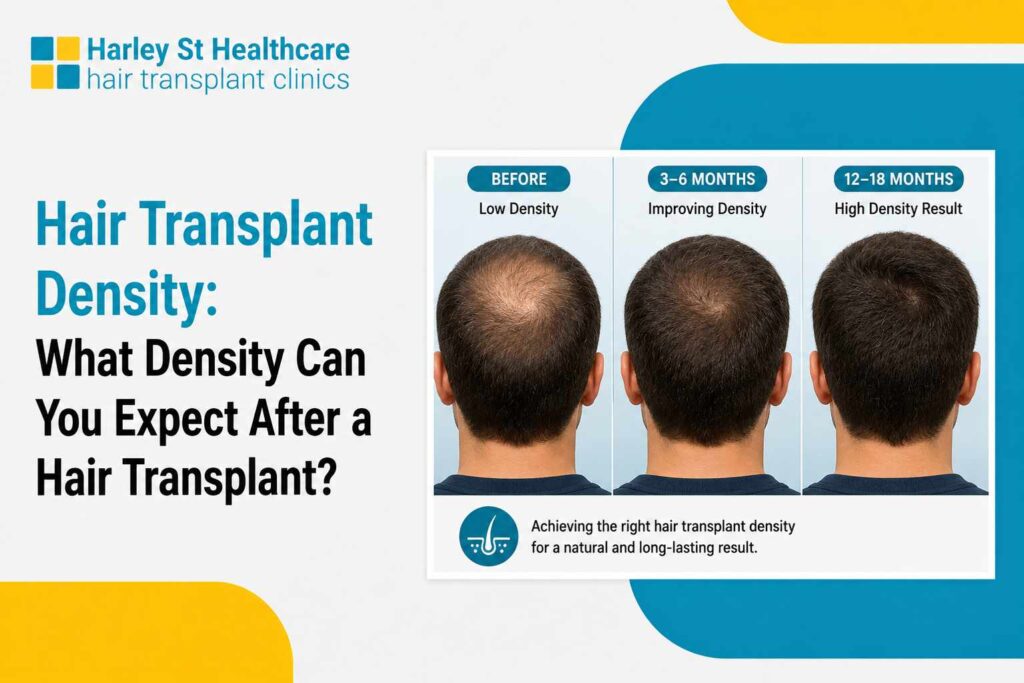
One of the most common questions patients ask before surgery is: “How dense will my hair look after a hair transplant?” While modern hair transplant techniques can restore a fuller appearance, it’s important to understand that a transplant doesn’t usually recreate the exact density you had before hair loss began. Instead, the goal is to achieve a natural-looking result with strong visual coverage using the available donor hair. In this guide, we’ll explain everything you need to know about hair transplant density, including grafts per cm², factors affecting density, realistic expectations, and whether high-density hair transplants are worth considering.
Table of Content
ToggleWhat Is Hair Transplant Density?
Hair transplant density refers to the number of transplanted hair grafts placed within a specific area of the scalp.
It is usually measured in:
Grafts per square centimetre (grafts/cm²)
Each graft contains between one and four hairs, depending on your genetics and donor hair characteristics.
The more grafts successfully implanted in an area, the fuller the hair can appear.
However, achieving density isn’t simply about packing as many grafts as possible into the scalp.
The placement, angle, direction, and survival rate of the grafts are equally important.
Understanding Natural Hair Density
Natural hair density varies from person to person.
On average:
Hair Type | Density |
Natural scalp density | 60–100 grafts/cm² |
High natural density | 80–120 grafts/cm² |
Cosmetic density needed for coverage | 30–50 grafts/cm² |
Interestingly, most people can lose up to 50% of their natural hair density before thinning becomes visibly noticeable.
This is why a hair transplant doesn’t need to replicate your original density to create a natural result.
How Much Density Can a Hair Transplant Achieve?
Most modern hair transplants achieve:
30–50 Grafts per cm²
This range is generally considered ideal for creating natural-looking coverage while maintaining healthy graft survival.
Some specialist clinics may perform high-density hair transplants with:
50–70 Grafts per cm²
However, higher density isn’t always better.
Placing too many grafts too close together can:
- Reduce blood supply
- Increase graft competition
- Lower graft survival rates
- Affect long-term results
The best surgeons focus on achieving visual density rather than simply increasing graft numbers.
Hair Transplant Density vs Visual Density
Many patients assume density is purely a numbers game.
In reality, visual density matters more than actual density.
Visual density refers to how thick and full the hair appears to the eye.
A skilled surgeon can create excellent visual density by:
- Strategic graft placement
- Natural hairline design
- Correct angulation of follicles
- Using multi-hair grafts behind the hairline
- Blending transplanted and existing hair
This approach often produces a fuller appearance without exhausting valuable donor hair.
Factors That Affect Hair Transplant Density
Several factors influence how much density can realistically be achieved.
1. Donor Hair Availability
Your donor area (typically the back and sides of the scalp) acts as the source of transplant grafts.
Patients with:
- Thick donor hair
- High donor density
- Strong follicular units
usually achieve better coverage.
Since donor hair is limited, it must be used strategically.
2. Extent of Hair Loss
Someone treating a small receding hairline may achieve greater density than someone restoring:
- Crown baldness
- Extensive diffuse thinning
- Advanced Norwood hair loss
The larger the area, the more donor grafts are needed.
3. Hair Characteristics
Hair calibre plays a huge role in perceived density.
Patients with:
- Thick hair shafts
- Curly hair
- Wavy hair
- Dark hair
often appear denser after transplantation than patients with fine, straight hair.
4. Scalp and Hair Colour Contrast
Low contrast between scalp and hair colour creates the illusion of fuller hair.
For example:
- Blonde hair on fair skin
- Grey hair on lighter scalp
often appears denser than dark hair on a pale scalp.
5. Surgical Technique
A highly experienced surgeon understands how to maximise density through:
- Proper graft distribution
- Natural hairline design
- High graft survival rates
- Strategic placement patterns
This can dramatically improve final results.
Can a Hair Transplant Increase Hair Density?
Yes.
In fact, increasing density is one of the primary reasons people undergo hair restoration surgery.
A hair transplant works by relocating healthy follicles from donor areas to thinning or balding regions.
This increases the concentration of hair follicles in sparse areas, resulting in:
- Better scalp coverage
- Reduced scalp visibility
- Fuller appearance
- Improved confidence
However, the amount of density gained depends on your donor supply and treatment goals.
What Is a High-Density Hair Transplant?
A high-density hair transplant typically involves placing:
50–70 grafts/cm²
in selected areas.
This technique aims to produce:
- Maximum fullness
- Strong cosmetic density
- Minimal scalp visibility
While attractive in theory, not every patient is suitable.
High-density procedures require:
- Excellent donor reserves
- Healthy scalp blood supply
- Experienced surgical planning
Overpacking grafts can sometimes reduce growth rates rather than improve them.
Hair Transplant Density Timeline
Density develops gradually after surgery.
Months 1–3
Transplanted hairs enter the shedding phase.
This is completely normal.
Many patients temporarily look similar to how they did before treatment.
Months 3–6
New hairs begin emerging.
Growth may appear thin and uneven initially.
Months 6–9
Significant thickening occurs.
Coverage improves noticeably.
Months 9–12
Hair becomes stronger, darker, and denser.
Most patients see major cosmetic improvements.
12–18 Months
Final density becomes visible.
The transplanted hair fully matures and blends naturally with surrounding hair.
How to Improve Hair Transplant Density
While your surgeon plays the biggest role, there are ways to maximise results.
Follow Aftercare Instructions
Proper aftercare improves graft survival during the critical healing phase.
Consider Finasteride
Many patients use Finasteride to preserve existing hair and support overall density.
Use Minoxidil
Minoxidil may encourage stronger hair growth and help maintain surrounding follicles.
Maintain Good Nutrition
Hair follicles require:
- Protein
- Iron
- Zinc
- Vitamin D
- Biotin
for healthy growth.
Consider a Second Procedure
Patients with extensive hair loss may benefit from a second transplant to further increase density.
Hair Transplant Density: Realistic Expectations
A successful hair transplant is not about recreating teenage hair density.
It’s about achieving:
Natural coverage
Improved fullness
Balanced hairline design
Long-term sustainability
Most patients achieve excellent cosmetic density with 30–50 grafts/cm², particularly when surgery is carefully planned.
Is a Hair Transplant the Best Option for Thin Hair?
If you’re experiencing:
- Receding hairline
- Crown thinning
- Male pattern baldness
- Diffuse thinning
a hair transplant may provide a permanent solution.
However, not everyone is an ideal candidate.
A professional consultation can assess:
- Donor hair quality
- Hair loss pattern
- Future hair loss risk
- Expected density outcomes
before treatment is recommended.
Why Choose Hair Transplant Clinics?
At Hair Transplant Clinics, we connect patients with leading hair restoration specialists who focus on creating natural-looking density rather than unrealistic graft numbers.
Every treatment plan is tailored to:
- Your hair characteristics
- Donor availability
- Hair loss stage
- Long-term goals
so you can achieve the most natural and sustainable result possible.
Conclusion
Understanding what density you can expect after a hair transplant helps set realistic expectations before treatment.
While a hair transplant cannot usually recreate natural hair density of 60–100 grafts per cm², most patients achieve excellent cosmetic results with 30–50 grafts per cm² through strategic graft placement and expert surgical planning.
Factors such as donor hair quality, hair characteristics, and the extent of hair loss all influence the final outcome. The key isn’t achieving maximum density—it’s creating a natural, fuller appearance that complements your existing hair and facial features.
If you’re considering a hair transplant and want to know what density is achievable in your case, a professional consultation is the best place to start.
FAQs
Most patients achieve between 30 and 50 grafts per cm², which is usually enough to create natural-looking coverage.
No. Natural hair density is often between 60 and 100 grafts per cm², but transplanted hair can still look full due to strategic placement.
Generally, 50–70 grafts per cm² is considered a high-density hair transplant.
Yes. Some patients choose a second procedure to improve density if sufficient donor hair remains available.
Not necessarily. Overpacking grafts can reduce survival rates and may negatively affect the final outcome.