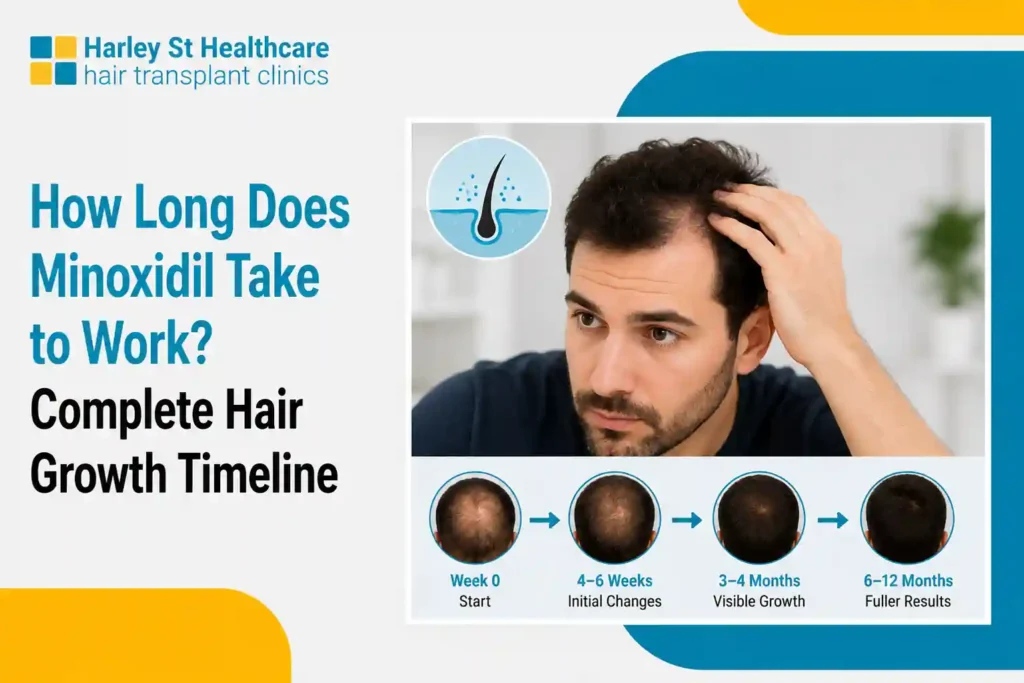
Hair loss can be frustrating, especially when you’re actively trying to reverse it. If you’ve recently started using Minoxidil, you’re probably wondering one thing: how long does Minoxidil take to work?
Table of Content
ToggleThe short answer is that most people start noticing early improvements within 3 to 4 months, while more significant hair regrowth usually appears between 4 and 6 months. However, achieving the best possible results often takes up to 12 months of consistent use.
Understanding the Minoxidil timeline can help you set realistic expectations and avoid giving up too soon. In this guide, we’ll explain how Minoxidil works, what results you can expect month by month, and how to maximise your chances of successful hair regrowth.
What Is Minoxidil?
Minoxidil is one of the most widely used and clinically proven treatments for hair loss.
Originally developed as a medication for high blood pressure, researchers discovered that one of its side effects was increased hair growth. This led to the development of topical Minoxidil products designed specifically for treating hair thinning and hair loss.
Today, Minoxidil is commonly used to treat:
- Male pattern baldness
- Female pattern hair loss
- Receding hairlines
- Crown thinning
- Diffuse hair thinning
Popular brands include Regaine Extra Strength Foam in the UK and Rogaine in the United States.
Does Minoxidil Work?
For many people, yes.
Minoxidil has been shown to help:
- Slow down hair loss
- Reduce hair shedding
- Improve hair density
- Stimulate new hair growth
- Thicken existing hair strands
However, results vary depending on factors such as age, genetics, the extent of hair loss, and how consistently the treatment is used.
People who begin treatment during the early stages of hair thinning typically experience the best outcomes.
Does Minoxidil Regrow Hair?
Minoxidil can regrow hair in areas where hair follicles are still alive but have become weakened or miniaturised.
If follicles have been inactive for many years, complete regrowth becomes less likely. This is why early intervention is important.
Does Minoxidil Stop Hair Loss?
Minoxidil can significantly reduce ongoing hair loss for many users.
While it doesn’t cure the underlying cause of androgenetic alopecia, it can help preserve existing hair and slow the progression of thinning.
How Does Minoxidil Work?
Although researchers do not fully understand every aspect of Minoxidil’s mechanism, several effects have been identified.
Increases Blood Flow to Hair Follicles
Minoxidil acts as a vasodilator, meaning it widens blood vessels around hair follicles.
This improved circulation helps deliver oxygen and nutrients that support healthy hair growth.
Extends the Hair Growth Phase
Hair grows in cycles consisting of growth, transition, and resting phases.
Minoxidil helps prolong the active growth phase, allowing hairs to grow longer and thicker.
Stimulates Dormant Follicles
Minoxidil may reactivate dormant follicles that are still viable, encouraging new hair growth in thinning areas.
Thickens Existing Hair
Many users notice stronger, thicker hair before seeing significant new growth.
How Long Does Minoxidil Take to Work?
Most people begin seeing early improvements after approximately 3 to 4 months of consistent use.
Typical expectations include:
Timeline | Expected Results |
Weeks 1–4 | Possible shedding phase |
Months 2–3 | Reduced hair loss |
Months 3–4 | Early regrowth may appear |
Months 4–6 | Noticeable improvements in density |
Months 6–12 | Peak results typically achieved |
Patience and consistency are essential. Hair growth is naturally slow, and visible changes take time.
Minoxidil Hair Growth Timeline
Weeks 1–4: Initial Shedding Phase
One of the most misunderstood parts of treatment is Minoxidil shedding.
Many users notice increased hair fall shortly after starting treatment.
This occurs because Minoxidil accelerates the hair cycle, causing older hairs to shed before stronger hairs replace them.
How Long Does Minoxidil Shedding Last?
For most people, shedding lasts between 2 and 8 weeks.
Although alarming, this phase is often a sign that the treatment is beginning to work.
Months 2–3: Reduced Hair Loss
During this period:
- Shedding usually decreases
- Hair loss stabilises
- Follicles become more active
- Existing hair may appear healthier
Visible regrowth is still limited for many users at this stage.
Months 3–4: Early Hair Regrowth
This is often when users begin noticing:
- Fine baby hairs
- Improved scalp coverage
- Reduced shedding
- Slight improvements in density
The first signs of Minoxidil hair regrowth become visible during this phase.
Months 4–6: Noticeable Improvements
For many people, this is where the transformation becomes more apparent.
Common improvements include:
- Increased hair density
- Thicker hair strands
- Fuller appearance
- Better coverage of thinning areas
This is when many Minoxidil before and after photos start showing meaningful changes.
Months 6–12: Peak Results
The most significant results typically occur between six and twelve months.
Benefits may include:
- Stronger hair growth
- Improved scalp coverage
- Increased density
- Better hair quality overall
Most users reach their peak results around the one-year mark.
Minoxidil Before and After: What Results Can You Expect?
Minoxidil before and after results vary significantly between individuals.
Several factors influence outcomes:
- Age
- Genetics
- Hair loss severity
- Treatment consistency
- Underlying health conditions
Minoxidil Before and After Men
Men often experience the greatest improvements in:
- Crown thinning
- Diffuse thinning
- Early-stage male pattern baldness
Results are generally strongest when treatment begins before extensive hair loss develops.
Minoxidil Before and After Women
Women commonly see:
- Improved density
- Better scalp coverage
- Reduced widening of the part line
- Less daily shedding
Consistent use is key to achieving meaningful improvements.
Oral Minoxidil Before and After
Oral Minoxidil has gained popularity in recent years.
Many users report:
- Strong overall regrowth
- Improved density
- Enhanced crown coverage
However, oral Minoxidil may also increase the likelihood of side effects and should only be used under professional guidance.
Does Minoxidil Work on a Receding Hairline?
Many people use Minoxidil specifically for hairline recession.
While Minoxidil can improve some cases of hairline thinning, results are generally more predictable in the crown area.
Hairline success depends on:
- How long the recession has existed
- Follicle viability
- Age
- Genetics
Early treatment usually produces better outcomes.
Oral Minoxidil vs Topical Minoxidil
Feature | Topical Minoxidil | Oral Minoxidil |
Application | Applied to scalp | Tablet |
Convenience | Moderate | High |
Prescription Required | Usually No | Often Yes |
Side Effects | Lower | Higher |
Scalp Irritation | Possible | Rare |
Effectiveness | Proven | Proven |
Both options can be effective, but the best choice depends on individual circumstances and medical advice.
Regaine Extra Strength Foam: How Long Does It Take to Work?
Regaine contains Minoxidil as its active ingredient.
The expected timeline is similar to other Minoxidil products:
- Initial shedding within weeks
- Early changes after 3–4 months
- Noticeable regrowth after 4–6 months
- Peak results around 12 months
Consistency remains the most important factor.
Signs Minoxidil Is Working
Not everyone notices dramatic regrowth immediately.
Positive signs include:
Reduced Hair Shedding
One of the earliest indicators of success.
New Baby Hairs
Fine hairs appearing in thinning areas suggest follicle activation.
Improved Hair Thickness
Hair strands may become stronger and thicker.
Better Scalp Coverage
Reduced visibility of the scalp is often a significant milestone.
Common Mistakes That Delay Minoxidil Results
Inconsistent Application
Skipping doses reduces effectiveness.
Stopping During the Shedding Phase
Many users quit too early because they mistake shedding for treatment failure.
Expecting Immediate Results
Hair growth takes months, not weeks.
Applying Incorrectly
Always follow product instructions carefully.
Ignoring Underlying Causes
Nutritional deficiencies, hormonal issues, and medical conditions may affect outcomes.
What Happens If You Stop Using Minoxidil?
Minoxidil requires ongoing use to maintain results.
If treatment stops:
- Regrown hair is usually lost
- Hair loss often resumes
- Density gradually decreases
Most users notice renewed shedding within a few months of discontinuing treatment.
What If Minoxidil Doesn’t Work?
If you’ve used Minoxidil consistently for 6 to 12 months without improvement, it may be worth exploring alternative options.
These may include:
- Finasteride
- PRP therapy
- Low-level laser therapy
- Combination treatments
- Hair transplant surgery
A professional consultation can help determine the most suitable treatment plan.
Why Choose Hair Transplant Clinics?
At Hair Transplant Clinics, we connect patients with leading hair restoration specialists who focus on achieving natural-looking, long-lasting results.
Every treatment plan is tailored to:
- Your hair characteristics
- Donor hair availability
- Stage of hair loss
- Existing hair density
- Long-term restoration goals
Whether you’re considering Minoxidil, PRP therapy, medical treatments, or a hair transplant, our network of trusted specialists can help you understand your options and create a personalised treatment strategy.
Our goal is to help every patient achieve the most natural and sustainable hair restoration result possible.
Conclusion
So, how long does Minoxidil take to work?
For most people:
- Shedding may occur during the first few weeks
- Early improvements appear after 3–4 months
- Noticeable regrowth develops between 4–6 months
- Peak results are achieved around 12 months
The key to success is consistency.
Whether you’re using topical Minoxidil, oral Minoxidil, or Regaine Extra Strength Foam, patience and regular application are essential for achieving the best possible results.
If you’re unsure whether Minoxidil is right for your situation, seeking professional advice can help you develop the most effective long-term hair restoration plan.
Frequently Asked Questions
Most users notice early improvements after 3–4 months, with significant results appearing between 4–6 months.
Yes, Minoxidil can stimulate regrowth in active hair follicles and improve hair density.
Typically between 2 and 8 weeks.
Yes, oral Minoxidil can be effective, although side effects may be more common than with topical formulations.
It can significantly slow hair loss and reduce shedding in many users.
Most users apply Minoxidil once in the morning and once in the evening, but consistency is more important than timing.
Results generally plateau after around 12 months, but continued use is necessary to maintain improvements.
This version is formatted and structured for direct publication in WordPress, with proper SEO hierarchy and keyword coverage.