Summary
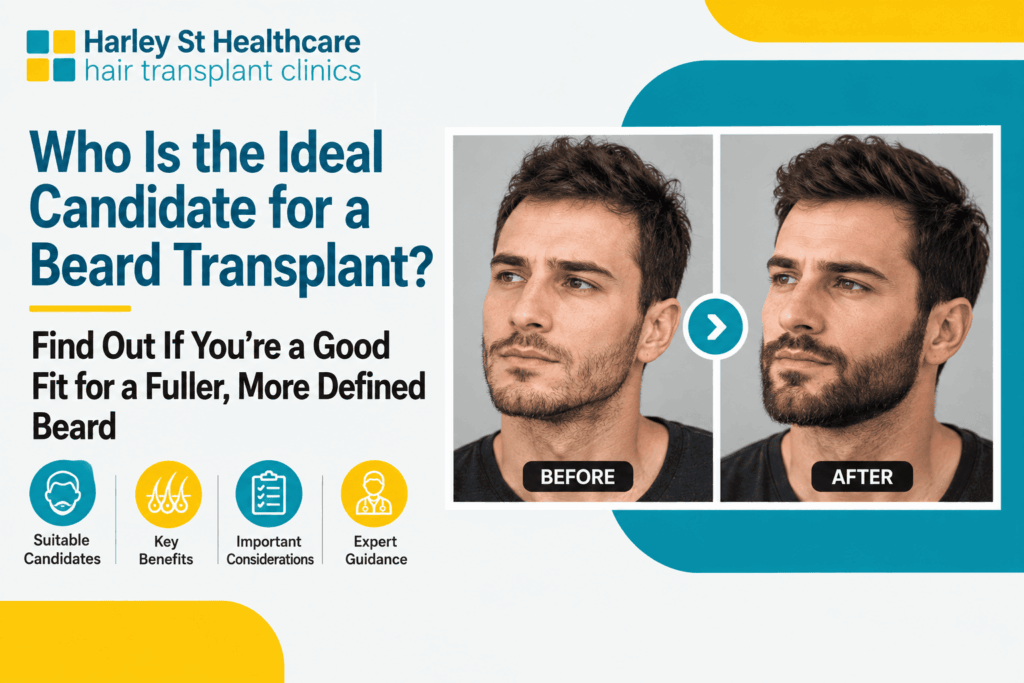
The ideal candidate for a beard transplant is generally an adult with patchy, sparse, uneven or limited facial hair who has enough suitable donor hair and realistic expectations about the procedure. Beard transplants can be used to improve areas such as the cheeks, jawline, moustache or sideburns, but suitability varies between individuals. A consultation with a qualified hair-restoration professional is needed to assess donor hair, facial hair growth, health, treatment goals and the number of grafts that may be required.
Table of Content
ToggleWhat Makes Someone a Good Beard Transplant Candidate?
A beard transplant may be considered by people who are unhappy with the density, shape or distribution of their facial hair. Common reasons include naturally sparse growth, patchy beard development, areas with little or no hair, or hair loss caused by injury or scarring.
A good candidate will generally have:
- A stable concern about beard density or coverage
- Sufficient healthy donor hair
- Facial hair growth that has reasonably matured
- Good general health for an elective procedure
- Realistic expectations about the outcome
- A clear understanding of the recovery and growth process
Having one of these characteristics does not automatically make someone suitable. A professional assessment is important before deciding whether transplantation is appropriate.
1. People With Patchy or Uneven Beard Growth
Patchy beard growth is one of the common reasons people consider a beard transplant.
For example, someone may have reasonable growth around the chin and moustache but noticeably thinner areas across the cheeks. Others may have gaps along the jawline or uneven sideburns.
A beard transplant can be planned around these areas, with individual follicles positioned to complement the existing beard. The aim is to create a natural transition between transplanted and existing hair rather than simply placing as many grafts as possible.
2. People With Naturally Sparse Facial Hair
Some men can grow a beard but find that it remains thin even after allowing it to grow fully.
In these situations, transplantation may be used to increase the appearance of density in selected areas. However, the amount of additional density possible depends on the available donor follicles and the characteristics of the existing beard.
A transplant redistributes existing hair follicles, so there is a limit to how much hair can be transferred.
3. People With Adequate Donor Hair
The donor area is one of the most important considerations when assessing beard transplant suitability.
Hair follicles are commonly taken from a suitable scalp donor area and transferred to the beard region. The clinician needs to determine whether the donor area has enough appropriate follicles to meet the treatment objective.
Factors that may be considered include:
- Donor hair density
- Hair thickness and texture
- Number of available grafts
- Quality of the donor area
- Existing beard density
- Size of the area requiring treatment
Someone with limited donor hair may still have treatment options, but the achievable coverage or density could be more restricted.
4. Adults With Established Beard Growth
Age can also be relevant when considering a beard transplant.
Facial hair can continue developing through the late teens and into the 20s. For this reason, younger individuals may be advised to wait until their natural beard pattern has become more established before undergoing a permanent procedure.
There is no single age that makes someone automatically suitable. Instead, the clinician should consider whether facial hair development has stabilised and whether transplantation is appropriate.
5. People With Realistic Expectations
Realistic expectations are essential.
A beard transplant can improve the appearance of sparse or patchy areas, but it cannot guarantee a particular density or reproduce another person’s beard exactly.
The final appearance can depend on:
- Number of transplanted grafts
- Donor hair characteristics
- Existing beard growth
- Skin and hair characteristics
- Hair growth cycle
- Healing
- Transplant design and placement
The goal should be a natural-looking improvement that suits the individual’s facial features and available donor hair.
Can Someone With No Beard Growth Have a Beard Transplant?
Having little or no natural beard growth does not automatically rule out transplantation.
Some people may have minimal facial hair but sufficient donor follicles elsewhere. In these cases, a clinician can assess whether transplantation could create or improve beard coverage.
However, someone with very little existing beard hair should have realistic expectations about the amount of density that can be achieved. The available donor supply ultimately limits how many follicles can be transplanted.
Who May Not Be Suitable for a Beard Transplant?
Not everyone is an appropriate candidate.
A beard transplant may need to be delayed or reconsidered if there is:
- Insufficient donor hair
- An unexplained or rapidly changing pattern of facial hair loss
- An active skin condition affecting the treatment area
- Certain uncontrolled health conditions
- Unrealistic expectations
- Beard growth that has not yet matured
If facial hair has suddenly become patchy or has started falling out, it is important to establish the cause before considering cosmetic hair transplantation.
How Is Beard Transplant Suitability Assessed?
During a consultation, the clinician should assess more than just the areas where facial hair is missing.
The assessment may include:
Existing beard growth: The density and distribution of current facial hair can help determine where grafts may be most useful.
Donor area: The clinician can examine the availability and quality of follicles that could potentially be transplanted.
Facial proportions: Beard design should complement the individual’s face rather than follow a one-size-fits-all pattern.
Hair characteristics: Hair thickness, texture and growth direction can influence the appearance of the final result.
Treatment goals: The clinician should understand whether the individual wants to fill small gaps, increase density or create greater overall coverage.
Expected graft requirement: The number of grafts needed depends on the size of the treatment area and the desired level of coverage.
How Many Grafts Does a Beard Transplant Require?
There is no standard graft number that applies to every beard transplant.
Someone looking to fill a few small gaps may require considerably fewer grafts than someone seeking greater coverage across the cheeks, jawline and moustache.
The number of grafts should therefore be determined after assessing the beard and donor area rather than choosing a fixed number in advance.
Conclusion
The ideal beard transplant candidate is usually someone with stable concerns about sparse, patchy or uneven facial hair, sufficient donor hair and realistic expectations.
A beard transplant is highly individualised. The amount of coverage, density and final appearance depend on the available donor follicles and the design of the treatment.
If you are considering a beard transplant, a professional consultation can help determine whether you are a suitable candidate and what outcome may realistically be achievable.
Frequently Asked Questions
A patchy beard can be one reason to consider transplantation, provided there is sufficient donor hair and the individual is otherwise suitable.
Possibly. Suitability depends largely on the availability of suitable donor follicles and the reason for limited facial hair growth.
There is no universal age. Facial hair should generally be sufficiently developed and stable before considering a permanent transplant.
Yes. Suitable follicles are commonly harvested from a scalp donor area and transplanted into areas requiring additional facial hair.
Not necessarily. The achievable density depends on donor hair availability, the treatment area, existing beard growth and individual healing and growth.