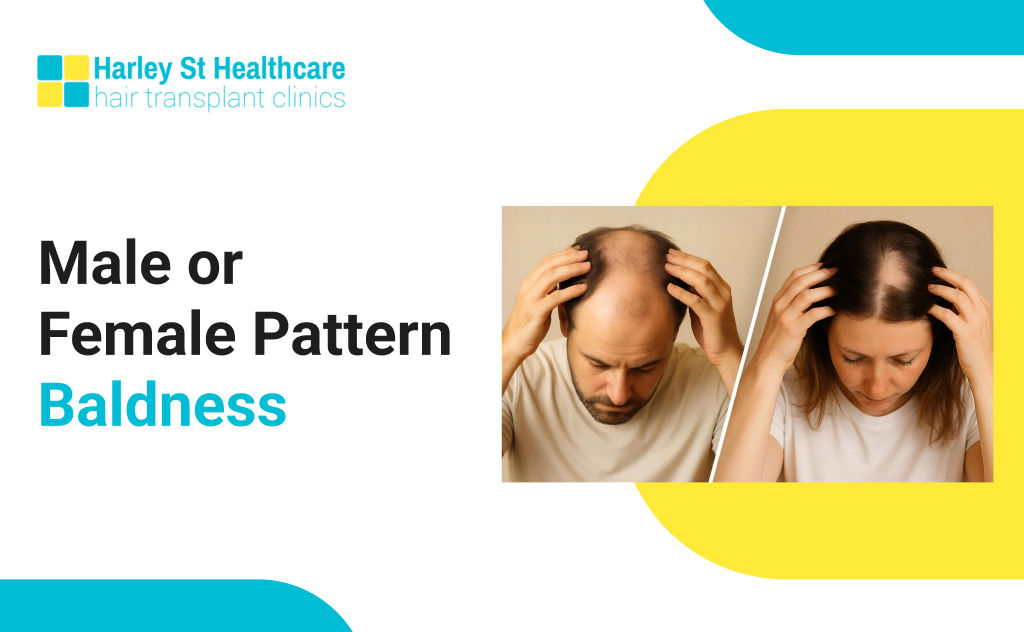
Male and female pattern baldness are the most prevalent causes of incurable hair loss in the UK, with millions of men and women experiencing it every year. This professional advisor of Hair-Transplant-Clinics.co.uk has provided the reasons, symptoms, diagnosis, treatment plan, recovery prognosis, and hair transplant appropriateness, so that you can make a decision on restoring your faith and your hair.
Hair-Transplant-Clinics.co.uk hair restoration experts reviewed.
What Is Pattern Baldness?
Pattern baldness or medically Androgenetic Alopecia, is a genetically associated disorder that is a result of sensitivity to the hormone DHT (dihydrotestosterone), and which causes progressively smaller hair follicles and slower growth.
Hair loss often affects much more than appearance, confidence, self-esteem and mental wellbeing can shift significantly as thinning progresses. Many patients experience anxiety and social discomfort during this stage, and understanding the psychological effects of male pattern baldness helps them feel less alone and more prepared for treatment decisions.
How It Works
DHT causes the hair root to become smaller and smaller as time passes and each growing cycle takes less time. Hair gets thinner, weak and permanently ceases to grow.
Why It Matters
The diagnosis of the disease at an early stage can respond to treatment better. When the follicles are thoroughly killed, no follicles are useful in non-surgical measures, and hair transplant is the only option that can be applied as a long-term solution.
Who It Affects
- Men with crumbling hairlines and a bald crown.
- Women with extensive thinning of the scalp.
- People who have relatives who have baldness.
- Individuals with age or hormonal alterations in hair.
Clinical Key Points
- Male pattern baldness is next to Norwood Scale.
- Ludwig or Sinclair Scale comes after female pattern baldness.
- The treatment plan is determined by the availability of donor hair, the density of the graft and its stage of severity.
- The success rate of hair transplantation is determined by the survival rate of the grafts and the choice of techniques (FUE/FUT/DHI).
Evidence-Based Comparison
Male vs Female Pattern Baldness
Factor | Male Pattern Baldness | Female Pattern Baldness |
Pattern | Receding front & crown | Overall diffuse thinning |
Scale | Norwood | Ludwig/Sinclair |
Candidate for Transplant | Most cases | Depends on donor density |
Common Tools | FUE, FUT, DHI | PRP + FUE selective |
Affected Hormone | DHT | DHT + Estrogen imbalance |
Hair Transplant vs Non-Surgical Treatments
Option | Suitable For | Strength |
FUE/FUT Hair Transplant | Permanent hair loss | Long-term, natural |
PRP Therapy | Early thinning | Growth stimulation |
Minoxidil | Diffuse thinning | Slows miniaturisation |
Finasteride (Men only) | DHT control | Reduces hair fall |
How much does a hair transplant cost in the UK?
It depends on the method and quantity of grafts required. An average FUE hair transplant is between £2500 and £6500 pounds and FUT costs about £3000 to £7000 pounds. In patients who may want to use advanced precision techniques, the DHI procedures tend to be in the price range of between £5,000 -£9,000 hence it is the expensive choice because of its meticulous implantation process and the natural density outcomes.
How long does recovery take after a hair transplant?
In most situations, early recovery and redness are resolved in 7-10 days, and patients resume regular life soon. Transplant hairs normally fall off in Weeks 2-6 and this is a natural growth cycle and does not indicate failure. The initial regrowth is seen at around Month 3 to Month 4 and natural outcomes normally fully develop after 9 to 12 months.
What are the risks or limitations after surgery?
Although the process can be said to be safe, temporary swelling, scabbing and shock shedding are all normal and should be expected during the process of hair transplant. These effects pass away naturally as the scalp cures and new hair starts growing.
Conclusion
Pattern baldness affects thousands across the UK, but effective treatments and permanent solutions are available. Understanding your hair loss stage and choosing the right treatment strategy is the key to achieving natural and lasting results.
Book your London Dermatology consultation today
FAQs
Female pattern baldness is a condition that cannot be completely cured but rather can be treated and enhanced using therapy such as Minoxidil, PRP, hormone balancing therapy and selective hair transplants in appropriate cases. Early diagnosis would provide the most reasonable opportunities of visible regrowth and retarded progression.
Pattern baldness in both males and females is mainly genetic and sensitive to the hormone DHT, which reduces the size of follicles with old age. The process can be increased by other reasons such as hormones, aging, stress, and medical conditions as well as nutritional deficiencies.
Patients with an extremely poor donor site, uncontrolled health issues or extreme diffuse loss (especially prevalent in women) might not obtain the best outcomes with transplant surgery. Also, individuals who have unrealistic dreams regarding the density or instant change might require counseling prior to deciding to go surgical with restoration.