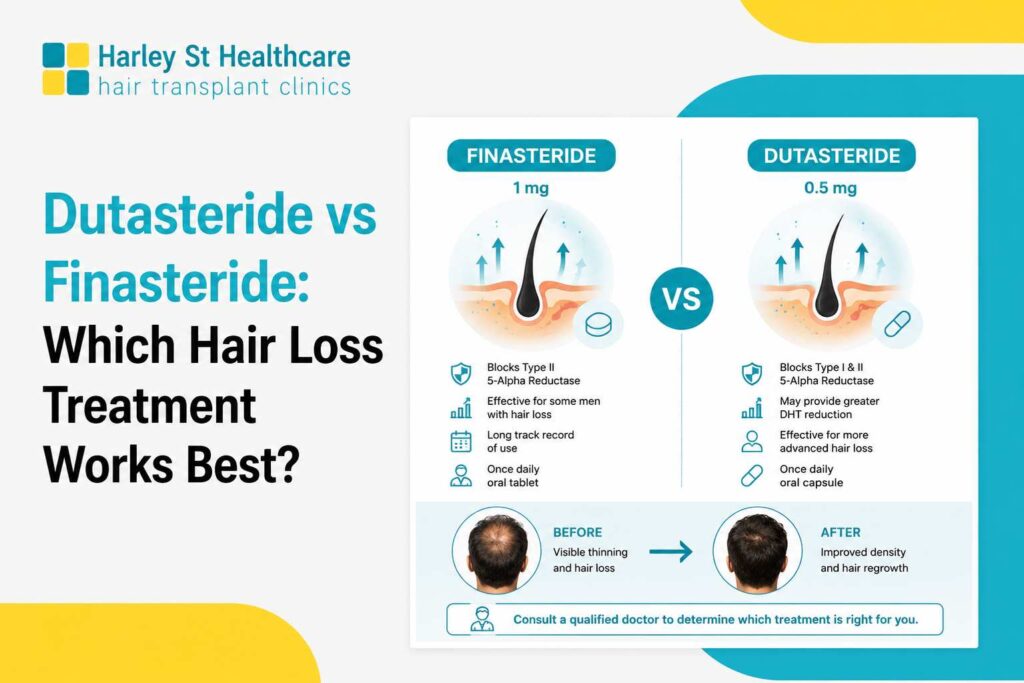
Male pattern hair loss (also called androgenetic alopecia) is mainly caused by a hormone called DHT (dihydrotestosterone). This hormone gradually shrinks hair follicles, leading to thinning, recession, and long-term hair loss. Two of the most commonly prescribed treatments are finasteride and dutasteride for hair loss. Many people compare them as finasteride vs dutasteride, trying to understand which one works better and whether dutasteride is stronger than finasteride. Both belong to the same class of drugs (5-alpha reductase inhibitors), but they differ in strength, effectiveness, and clinical use.
Table of Content
ToggleHow Finasteride Works
Finasteride is usually the first-line treatment for male pattern baldness.
It works by blocking the type II 5-alpha reductase enzyme, reducing DHT levels in the scalp.
Key effects of finasteride:
- Lowers DHT by around 60–70%
- Slows hair thinning and shedding
- Helps maintain existing hair
- Supports mild regrowth
Finasteride is often recommended for early-stage hair loss and long-term maintenance.
Many users search for:
- finasteride vs dutasteride
- finasteride or dutasteride
- finasteride alternative
How Dutasteride Works
Dutasteride is a more powerful medication often compared as dutasteride vs finasteride hair loss treatment option.
It blocks both type I and type II 5-alpha reductase enzymes, resulting in stronger DHT suppression.
Key effects of dutasteride:
- Reduces DHT by up to 90%
- Stronger control of hair loss
- Better improvement in density in many cases
- Often used when finasteride does not work well
This is why many people ask:
- is dutasteride better than finasteride
- does dutasteride work better than finasteride
- is dutasteride stronger than finasteride
Finasteride vs Dutasteride: Key Differences
Feature | Finasteride | Dutasteride |
Enzyme blocking | Type II only | Type I + II |
DHT reduction | 60–70% | Up to 90% |
Strength | Standard | Stronger |
Best use | Early hair loss | Moderate to advanced loss |
Regrowth potential | Moderate | Higher |
Which Is Better: Finasteride or Dutasteride?
When comparing finasteride vs dutasteride for hair loss, studies show that dutasteride is generally more effective in increasing hair count and thickness.
However, finasteride still works very well for many men, especially in early stages.
Simple breakdown:
- Finasteride = stabilises hair loss
- Dutasteride = stronger regrowth + stronger DHT suppression
So the answer to which is better finasteride or dutasteride depends on the stage of hair loss.
Hair Loss Patterns and What Works Best
Different patterns respond differently:
- Receding hairline → dutasteride works better
- Crown thinning → both finasteride and dutasteride work
- Diffuse thinning → either option
- Advanced hair loss → dutasteride preferred
This is why users often compare:
- finasteride versus dutasteride
- dutasteride vs finasteride hair loss
How Long Do Results Take?
Finasteride:
- 3 months: reduced shedding
- 6 months: stabilisation
- 12 months: visible improvement
Dutasteride:
- 2–3 months: stronger DHT reduction begins
- 6 months: visible density changes
- 12 months: full results
Even though dutasteride reduces DHT faster, visible regrowth still takes time due to the natural hair cycle.
Side Effects: Dutasteride vs Finasteride
Both medications are generally safe, but side effects may include:
- Reduced libido
- Erectile dysfunction
- Reduced semen volume
- Mood changes (rare)
- Scalp irritation
This leads many people to search:
- dutasteride vs finasteride side effects
- finasteride vs dutasteride side effects
- dutasteride side effects vs finasteride
- is dutasteride safer than finasteride
Key point:
- Finasteride leaves the body faster
- Dutasteride stays longer in the system
Can You Switch from Finasteride to Dutasteride?
Yes, switching is common in hair loss treatment.
Many patients move to dutasteride if:
- finasteride results are not strong enough
- hair loss continues
- stronger DHT blocking is needed
This is a common real-world transition in finasteride vs dutasteride treatment plans.
Can You Take Finasteride and Dutasteride Together?
In most cases, doctors do NOT recommend combining them.
Both target the same pathway, so taking them together:
- does not significantly improve results
- may increase risk of side effects
Alternatives to Finasteride and Dutasteride
If you are exploring a finasteride alternative, options include:
- Minoxidil
- PRP therapy
- Hair transplant
- Lifestyle and scalp treatments
These are often used in combination for better results.
Cost Comparison
- finasteride vs dutasteride cost varies by brand and region
- Finasteride is usually cheaper
- Dutasteride is slightly more expensive
Who Should Use What?
Finasteride is best for:
- Early hair loss
- Maintenance
- First-time treatment
Dutasteride is best for:
- Moderate to advanced hair loss
- Faster progression
- Stronger regrowth needs
Expert Guidance for Hair Loss Treatment
Choosing between finasteride or dutasteride is not always simple. It depends on your hair loss stage, response to medication, and long-term expectations.
At Hair Transplant Clinics, we help patients understand their hair loss pattern and choose the most suitable medical or surgical treatment plan.
Conclusion
The debate of dutasteride vs finasteride depends on individual needs.
Finasteride is highly effective for early-stage hair loss and maintenance, while dutasteride is stronger and often used for more advanced cases.
Instead of asking only “which is better,” the real answer is: the right treatment depends on your stage of hair loss and how your body responds.