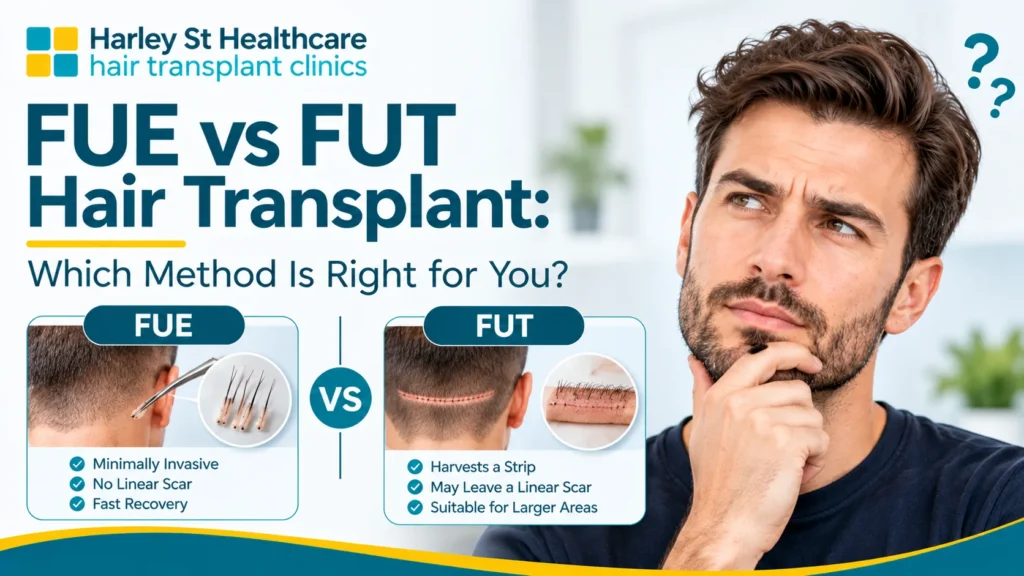
If you are weighing up FUE vs FUT, you have probably already noticed that every clinic seems to recommend whichever one it offers. The honest answer is that neither method is better for everyone. FUE and FUT move the same kind of hair to the same kind of areas. The real difference is how the hair is taken from the back and sides of your head, and what that means for scarring, recovery, graft numbers and your future options.
Table of Content
ToggleWhether you search FUE vs FUT or FUT vs FUE, the question is the same. This guide walks through both methods in plain English, so you can ask better questions at your consultation.
The short answer
- FUE (follicular unit extraction) removes grafts one at a time with a tiny punch. It leaves small dot scars, suits short hairstyles and usually has a quicker visible recovery.
- FUT (follicular unit transplantation) removes a thin strip of scalp from the donor area, closes it with stitches and splits it into grafts under a microscope. It leaves one fine linear scar, can yield more grafts in a single session and suits people who wear their hair longer.
How FUE works
In FUE, the surgeon uses a small motorised or manual punch to take individual follicular units directly from the donor area. The donor hair usually needs to be trimmed short, and some patients choose to shave it, so it works best if you are happy to wear your hair short, or if the area can be hidden by the hair above it. The grafts are then placed into tiny channels in the thinning area.
Because every graft is taken separately, FUE sessions can be long, especially for larger graft counts. You can read more about the technique on our FUE hair transplant page.
How FUT works
With FUT, sometimes called the strip method, the surgeon removes a narrow strip of scalp from the back of the head and closes the gap with stitches or staples. A team then separates the strip into individual grafts under magnification, and these are implanted in the same way as with FUE.
The scar sits in a line across the back of the head. In most people, it is easy to cover with hair a few millimetres long, though it can widen in some cases. We cover the method in detail in our guide to FUT hair transplants.
FUE vs FUT hair transplant: side by side
| Factor | FUE | FUT |
|---|---|---|
| How donor hair is taken | Individual grafts, one by one | A thin strip of scalp |
| Scarring | Tiny dot scars scattered through the donor area | One fine linear scar |
| Best for hairstyles | Short or shaved styles | Medium to long hair that covers the scar |
| Typical visible recovery | Around 7 to 14 days | Around 10 to 14 days, plus stitch care |
| Discomfort afterwards | Usually mild | Often a little more, with tightness at the donor site |
| Graft numbers in one session | Good, but often capped by donor area and time | Often higher in a single sitting |
| Body or beard hair as donor | Possible in some cases | Not possible |
| Session length | Usually longer for large graft counts | Often shorter for the same number of grafts |
These are general trends. Your surgeon’s experience and your own hair characteristics change the picture.
Scarring: the biggest myth
A common claim is that FUE is scarless. It is not. FUE leaves many tiny round scars instead of one line, and if too many grafts are taken from the same zone, those dots can become visible as the donor area thins. FUT leaves a single scar that is easy to see if you shave your head very short. The right question is not which method scars, but which scar pattern suits your hairstyle and your long-term plans.
Graft numbers and your donor area
Your donor supply is limited, and every procedure uses some of it. FUT can offer a higher graft count in one session, which matters if you need extensive coverage. FUE spreads the harvest across a wider area, which can make it harder to go back for repeated sessions if your donor zone is already thin.
It helps to understand what a graft is before you compare numbers. Our explainer on grafts versus hairs shows how clinics count, and why a bigger number is not always a better result.
Recovery: what to expect
FUE generally has a quicker visible recovery because there are no stitches and no long wound. Small scabs form in the donor area and usually clear within one to two weeks. With FUT, you will have stitches or staples that need removing or dissolving, and the donor area can feel tight for a while, so heavy lifting and stretching are usually restricted.
In both cases the transplanted area follows the same pattern: scabbing, temporary shedding and slow regrowth over 9 to 12 months. See our guides on aftercare and the healing process for a stage-by-stage view.
Cost
In the UK, FUE is often quoted at a higher price per graft than FUT because it takes longer and needs more staff time. Some clinics price both methods the same, and the final total depends mostly on the number of grafts. Always ask for a written quote that shows the price per graft and the graft count. Our UK cost guide has more detail.
Who usually suits which method?
FUE may suit you if
- You wear your hair short or like the option of a buzz cut.
- You want to avoid a linear scar.
- You need a small to medium number of grafts.
- You want the quickest visible recovery.
FUT may suit you if
- You need a large number of grafts in one session.
- You keep your hair long enough to cover a thin line.
- You want to preserve donor reserves for future sessions.
- You have tightly curled hair, where FUE extraction can be harder.
For women, or anyone who does not want a shaved donor area, FUT or a trimmed-donor FUE approach may be discussed. A surgeon will look at your scalp laxity, hair characteristics and pattern of loss before advising. You can see how the main options compare in our guide to types of hair transplants.
Questions to ask at your consultation
- Which method do you recommend for me, and why?
- How many grafts do I realistically need, now and in the future?
- How much donor hair do I have to spare?
- Who will perform each step of the procedure?
- What will the donor area look like if I wear my hair short?
- Can you show me results from patients with a similar hair type?
Frequently asked questions
Not automatically. FUE suits people who want to avoid a linear scar and wear their hair short. FUT can be a better choice when you need many grafts or want to protect your donor area for future sessions. The best method is the one that fits your hair, your hairstyle and your goals.
FUT leaves one linear scar, which is easy to hide under longer hair but can show if you shave your head. FUE leaves many tiny dots that are harder to spot, but they can show if the donor area thins out.
Both are done under local anaesthetic. Afterwards, FUE is usually reported as milder, while FUT can feel tight around the stitched area for a few days.
Yes. Some patients have FUT first and FUE later, for example to use remaining donor hair or to disguise a scar. Your surgeon can plan this around your donor supply.
Once the transplanted hair has grown, the results look the same when the hairline design, density and skill of the surgeon are equal. The difference lies in the donor area, not the front.
Next step
The right method comes from an examination of your scalp and a conversation about your goals, not from a brochure. If you would like a personalised recommendation, book a consultation with the team at Harley St Healthcare and we will talk you through both options.
This article is general information and not a substitute for medical advice. Always speak to a surgeon about your own situation to get the best treatment.