Blog Summary
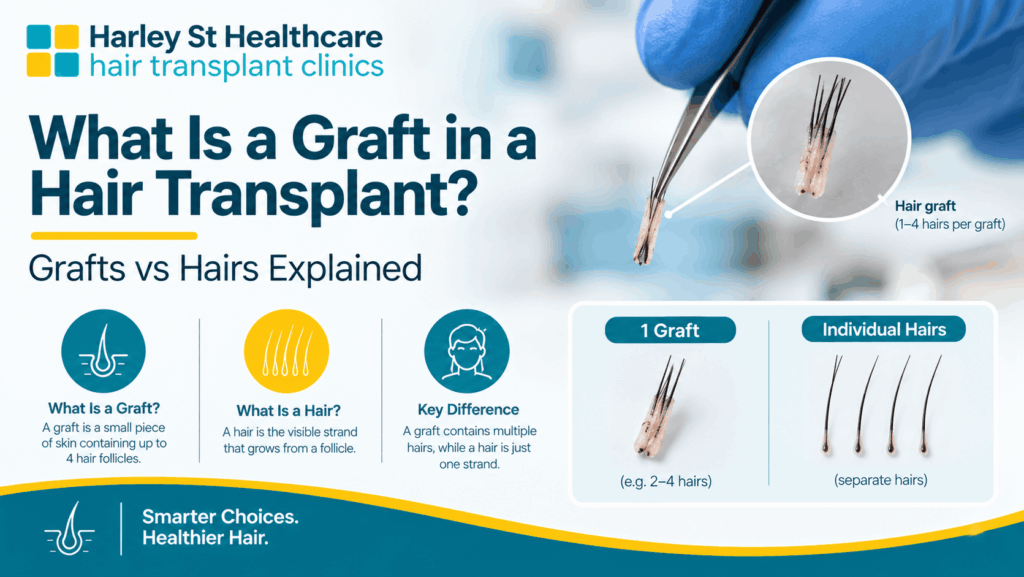
A graft in a hair transplant is a tiny piece of tissue holding one natural group of hair follicles, called a follicular unit. Each graft contains 1 to 4 hairs, around 2 on average, so 2,000 grafts usually means roughly 4,000 to 5,000 hairs, not 2,000. Clinics plan and price hair transplants in grafts, which is why knowing the difference matters when you read a quote.
Table of Content
ToggleIf you have had a hair transplant quote, you have probably seen a figure like 2,000 or 3,000 grafts. It is easy to read that as 2,000 or 3,000 hairs, but that is not what it means. A graft in a hair transplant is not a single hair, and mixing the two up is one of the most common points of confusion we hear about at consultation.
This guide explains what a hair graft actually is, how grafts compare with hairs, where different grafts are placed on the scalp and how grafts relate to hair transplant density. By the end, you should be able to look at any graft quote and know what it really means for you.
What is a graft in a hair transplant?
Scalp hair does not grow as single, evenly spaced strands. It grows in small natural clusters of hairs that share the same patch of skin, oil gland and blood supply. These clusters are called follicular units. Studies of the scalp going back to the 1980s show that each unit holds 1 to 4 hairs, and Bernstein Medical’s guide to follicular units shows what these groups look like under a microscope.
A hair graft is one of these follicular units, taken from the donor area together with the small amount of tissue around it. That tissue matters. It protects the follicles while they are outside the body and helps them connect to a new blood supply once they are placed in the thinning area.
So when a surgeon talks about a graft in a hair transplant, they mean one follicular unit, moved as a whole, with everything it needs to keep growing. The NHS guide to hair transplants describes grafts in the same way, as pieces containing 1 to 4 hairs.
Graft, follicle and hair: what is the difference?
- Hair: the visible strand you can see and style.
- Follicle: the small structure under the skin that grows one hair.
- Graft: a follicular unit, a natural group of 1 to 4 follicles moved together during surgery.
One graft can therefore hold a single follicle and a single hair, or up to four follicles and four hairs.
Single, double, triple and quadruple hair grafts
Surgeons sort grafts by how many hairs each one holds, because each type has a different job.
- 1-hair grafts look fine and soft, so they are used for the very front edge of the hairline.
- 2-hair grafts are very common and are used just behind the hairline and through the front of the scalp.
- 3-hair grafts add bulk and are placed further back, where you want the most fullness.
- 4-hair grafts are less common and are saved for areas that need the most density, away from the hairline.
The mix you have depends on your genes, hair type and the density of your donor area. That is why two people having 2,000 grafts can end up with quite different hair counts.
Grafts vs hairs: why the numbers confuse patients
Because most grafts hold more than one hair, the number of hairs moved is always higher than the number of grafts. Across most scalps the average is around 2 hairs per follicular unit, sometimes a little more. A simple rule of thumb is to multiply the graft number by 2 to 2.5 for a rough hair count.
| Number of grafts | Approximate number of hairs |
|---|---|
| 500 grafts | 1,000 to 1,250 hairs |
| 1,000 grafts | 2,000 to 2,500 hairs |
| 1,500 grafts | 3,000 to 3,750 hairs |
| 2,000 grafts | 4,000 to 5,000 hairs |
| 2,500 grafts | 5,000 to 6,250 hairs |
| 3,000 grafts | 6,000 to 7,500 hairs |
These figures are estimates. Your real number depends on how many hairs your own follicular units hold, which your surgeon checks in the donor area at consultation.
Why this matters when you compare quotes
Most UK clinics price hair transplant grafts individually or in graft bands. If one clinic quotes in grafts and another talks about hairs, the numbers are not like for like. A procedure advertised as 6,000 hairs might only be around 2,500 to 3,000 grafts. Before you compare prices, ask each clinic:
- Is this quote in grafts or in hairs?
- How many hairs per graft do you expect from my donor area?
- Is the price fixed, or does it change if more or fewer grafts are taken on the day?
For a full breakdown of prices, read our guide to how much a hair transplant costs in the UK.
Where do hair transplant grafts go?
A natural result depends on putting the right graft in the right place, not just moving a large number of them.
- Hairline: single-hair grafts go at the front edge. A natural hairline is soft and slightly uneven, and multi-hair grafts here would look tufted.
- Behind the hairline and mid-scalp: 2-hair and 3-hair grafts build density and give the look of fullness from the front.
- Crown: a mix of grafts placed to follow your natural swirl. The crown is a large area, so it can take a lot of grafts for a modest change in coverage.
Your surgeon also sets the angle and direction of every graft to match the hair around it. Together with careful graft sorting, this is why a modern transplant looks like your own hair rather than the “plugs” people remember from decades ago.
How grafts affect hair transplant density
Hair transplant density is usually measured in grafts, or follicular units, per square centimetre. A full, non-thinning scalp has roughly 80 to 100 follicular units per square centimetre, and this varies from person to person.
You do not need to replace all of that to look full. Most people lose around half their hair in an area before thinning becomes obvious, and the same rule helps a transplant. Surgeons commonly place around 30 to 50 grafts per square centimetre, and at that level many people get the look of good coverage.
Two other things change how dense the result looks:
- Hairs per graft: grafts with more hairs give more coverage for the same graft count.
- Hair type and colour: thick, wavy or curly hair, and hair close to your skin tone, covers more scalp than fine, straight hair that contrasts with the skin.
You can read more in our guide to hair transplant density and what you can expect.
Where do the grafts come from?
Grafts are taken from your own donor area, usually the back and sides of the head. Hair there is generally resistant to DHT, the hormone behind male pattern hair loss, so it tends to keep growing after it is moved. Our article on the importance of the hair donor area explains why this part of the scalp is so valuable.
There are two main ways to take grafts:
- FUE hair transplant: grafts are removed one at a time with a very small punch, leaving tiny dot scars spread across the donor area.
- FUT hair transplant: a thin strip of skin is removed and divided into individual grafts under magnification, leaving a fine line scar that is usually hidden by hair.
With either method, a follicle that has been taken does not grow back in the donor area. Your donor supply is limited, so a good surgeon plans with future hair loss in mind and does not take more grafts than the area can safely give.
How many grafts survive?
Grafts are living tissue, so how they are handled affects how well they grow. The time they spend outside the body, keeping them cool and moist, and gentle handling during placement all play a part. With careful technique most grafts survive and grow, but no honest clinic can promise that every single one will. Our article on graft survival rate in FUE transplants explains what affects it.
It is also normal for transplanted hairs to fall out a few weeks after surgery. The follicle stays in place, and according to the NHS new hair usually starts to appear at around 4 months, with full results seen at 10 to 18 months. Our guide on how long it takes for new hair to grow after a transplant covers the timeline month by month.
How many grafts will you need?
The right number of grafts depends on how large the thinning area is, how much density you want, the strength of your donor area and your hair type. As a rough guide, restoring a receding hairline often needs fewer grafts than covering the front, top and crown together. Your surgeon will also hold some donor grafts back in case you need treatment later in life.
We cover this in detail in our post on how many hair grafts you need, and you can get a quick estimate with our hair transplant calculator. Only an in-person assessment can give you an accurate number.
Hair grafts at Harley St Healthcare
We have clinics in London, Manchester and Birmingham, and every patient starts with a free consultation. One of our surgeons examines your donor area, checks how many hairs your grafts are likely to hold and gives you a clear quote in grafts, along with the hair count you can expect. That way you know exactly what you are paying for before you decide.
If you want to know how many grafts you need and what they will give you, book a free consultation or call 0207 030 3364.
Hair Graft FAQs
No. One graft is a follicular unit that holds 1 to 4 hairs, around 2 on average. That is why the number of hairs moved in a transplant is always higher than the number of grafts.
Around 4,000 to 5,000 hairs for most people. The exact figure depends on how many hairs your own follicular units hold, which your surgeon checks at consultation.
It is a moderate procedure. It can be enough to rebuild a receding hairline and part of the front of the scalp, but it would not cover a large bald area at full density. Whether it is right for you depends on the size of the area and your donor supply.
No. A follicle that has been taken does not regrow. The hair left around it covers the area, which is why surgeons spread extractions out and plan around your lifetime donor supply.
No. Grafts hold 1, 2, 3 or 4 hairs. Surgeons sort them and use single-hair grafts at the hairline and larger grafts further back to create density.
Grafts come from the back and sides of the head, where hair is generally resistant to the hormone that causes male pattern hair loss, so they usually keep growing long term. Your original hair around them can still thin over time, so your surgeon may talk to you about ways to protect it.