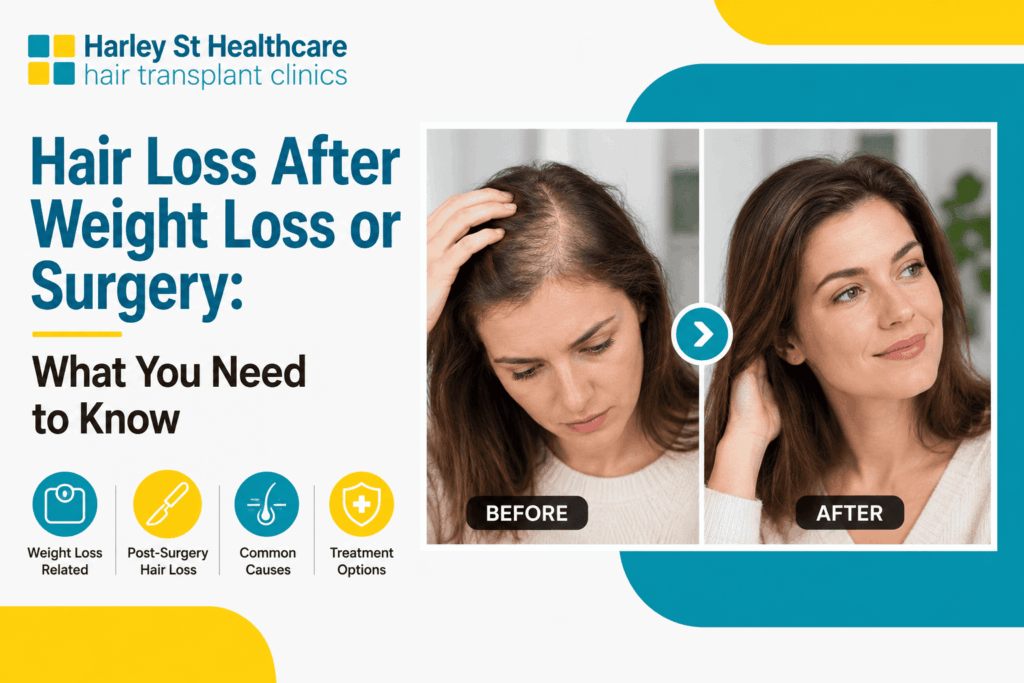
Losing hair after a period of significant weight loss or following surgery can be unsettling, particularly when you are already focused on recovering and adjusting to physical changes.
Table of Content
ToggleThe good news is that hair loss after weight loss and hair loss after surgery are often temporary. One common explanation is telogen effluvium, a type of excessive hair shedding that can occur after physical stress, rapid weight loss, major surgery or changes in nutrition.
Hair shedding may not begin immediately. In many cases, it becomes noticeable a few months after the triggering event, which can make it difficult to connect the two.
However, not every case of hair loss is caused by weight loss or surgery. Nutritional deficiencies, hormonal changes, hereditary hair loss and other conditions can also contribute. Understanding the pattern and timing of your shedding can help determine when professional assessment may be appropriate.
Why Does Hair Loss Happen After Weight Loss or Surgery?
The most common explanation is that the body has experienced a significant physical stressor or change.
Your hair follicles naturally move through growth, transition and resting phases. When the body experiences a major change, more follicles than usual can enter the resting phase. These hairs can then shed later, resulting in noticeable thinning.
This process is known as telogen effluvium.
Common telogen effluvium causes include:
- Major surgery
- Rapid or significant weight loss
- Very restrictive diets
- Inadequate protein or calorie intake
- Nutritional deficiencies
- Severe illness or infection
- High fever
- Significant emotional or physical stress
- Certain hormonal changes
- Some medications
The American Academy of Dermatology specifically identifies significant weight loss and operations among situations that can trigger excessive hair shedding.
Why Can Surgery Trigger Hair Shedding?
Surgery places physical stress on the body. Recovery also changes the body’s nutritional and metabolic demands.
After a major operation, the body prioritises essential recovery processes. Hair growth is not an immediate priority, so some follicles may temporarily shift into the resting phase.
This can result in hair loss after surgery several weeks or months later, rather than during the operation itself.
Major surgery is a recognised trigger for telogen effluvium.
Why Can Weight Loss Cause Hair Loss?
Rapid weight loss can affect hair growth in several ways.
If weight loss involves a substantial reduction in calorie intake, the body may receive less protein and fewer nutrients needed to support normal hair growth. Rapid changes in the body can also act as a physiological stressor.
The American Academy of Dermatology notes that people can experience excessive shedding after losing significant weight, with the shedding often appearing a few months after the event.
This means hair loss after weight loss does not necessarily mean that the weight-loss treatment itself has permanently damaged your hair. The underlying trigger may be the speed of weight loss, nutritional changes or the body’s response to the physical change.
What Is Telogen Effluvium?
Telogen effluvium is a temporary form of excessive hair shedding that occurs when more hair follicles than usual enter the resting phase of the hair-growth cycle.
It is commonly triggered by a significant change or stressor affecting the body, including surgery, rapid weight loss, illness, restrictive diets and severe stress.
Unlike some forms of permanent hair loss, telogen effluvium generally does not destroy the hair follicle.
Typical signs include:
- More hair than usual in the shower
- Increased hair on your pillow or clothing
- Hair coming out during brushing
- Overall thinning across the scalp
- A thinner ponytail
- Reduced hair volume
Telogen effluvium usually causes diffuse shedding rather than one clearly defined bald patch. The scalp itself generally looks healthy, without significant redness, scaling, burning or pain.
When Does Hair Loss Start After Weight Loss or Surgery?
One of the most confusing aspects of telogen effluvium is the delay between the trigger and the shedding.
Hair loss may become noticeable around two to three months after the triggering event, although the timing varies between individuals.
For example:
Surgery → recovery period → several weeks/months → increased shedding
or:
Rapid weight loss → physiological change → several weeks/months → noticeable hair shedding
Because of this delay, people often assume that something else must have caused their hair loss.
Looking back at significant changes in your health, diet, weight or medication during the preceding few months can therefore be useful when discussing hair loss with a healthcare professional.
How Long Does Hair Shedding Last?
How long does hair shedding last? There is no single timeline for everyone, but acute telogen effluvium commonly lasts for several months.
Cleveland Clinic describes acute telogen effluvium as lasting less than six months, with shedding often occurring two to three months after the trigger.
The American Academy of Dermatology notes that once the trigger has settled, excessive shedding usually stops and many people regain their normal fullness within around six to nine months.
After bariatric surgery, recovery can sometimes take longer. An NHS bariatric service notes that hair loss after bariatric surgery is common and usually temporary, often resolving within the first year.
The exact timeline depends on:
- The cause of the shedding
- How significant the physical stress was
- Whether rapid weight loss is continuing
- Nutritional status
- Whether another type of hair loss is also present
Is Hair Loss After Weight Loss Permanent?
Usually, hair shedding caused by telogen effluvium is temporary.
Once the underlying trigger has settled, affected follicles can return to their normal growth cycle and new hairs can begin growing.
However, temporary shedding can sometimes make another type of hair loss more noticeable.
For example, someone may already have early androgenetic alopecia (pattern hair loss) but only become aware of thinning after experiencing a period of heavy shedding.
This is why persistent thinning should not automatically be attributed to weight loss or surgery.
Can Hair Grow Back After Weight Loss or Surgery?
In many cases, yes.
If the shedding is caused by telogen effluvium, the follicles generally remain capable of producing new hair. Once the triggering factor has been addressed, the growth cycle can gradually normalise.
However, hair regrowth is slow. You may notice short new hairs before you see a significant improvement in overall density.
It is also important to distinguish regrowth from recovery of visible thickness. Even when the follicles have resumed producing hair, it can take months for the new strands to grow long enough to noticeably increase volume.
Can Nutritional Deficiencies Cause Hair Loss After Weight Loss?
Yes. Nutritional changes can contribute to hair shedding, particularly when weight loss involves restrictive eating or surgery that affects dietary intake.
Nutrients involved in maintaining healthy hair include:
- Protein
- Iron
- Zinc
- Vitamin B12
- Other vitamins and minerals required for normal body function
However, it is important not to assume that taking a particular supplement will solve hair loss.
If a deficiency is suspected, a healthcare professional can determine whether assessment or blood testing is appropriate. Taking high-dose supplements without establishing a deficiency can be unnecessary and, in some cases, harmful.
Hair Loss After Bariatric Surgery
People who undergo bariatric procedures may have additional nutritional considerations because their food intake changes substantially, and some procedures can affect nutrient absorption.
For this reason, following the nutritional and supplement guidance provided by your bariatric team is important.
An NHS bariatric service recommends maintaining adequate protein intake and continuing prescribed vitamin and mineral supplementation after surgery.
If you experience prolonged hair shedding after bariatric surgery, discuss it with your healthcare team rather than simply increasing supplements yourself.
How Can You Reduce Hair Shedding After Weight Loss or Surgery?
There is no guaranteed way to stop telogen effluvium immediately. The focus should be on identifying and addressing the underlying trigger.
Maintain Adequate Nutrition
Avoid extreme or highly restrictive diets.
Your body requires adequate energy and protein for normal physiological functions, including healthy hair growth. If you have undergone weight-loss surgery, follow the dietary plan provided by your healthcare team.
Follow Your Recommended Supplement Plan
If your doctor, dietitian or surgical team has recommended vitamins or minerals, take them as directed.
Do not add high-dose supplements simply because you are experiencing hair shedding.
Avoid Rapid, Unsupervised Weight Loss
Rapid changes in weight can place additional physiological stress on the body and may contribute to telogen effluvium. The American Academy of Dermatology advises people using weight-loss medicines to discuss hair loss concerns with a dermatologist and notes that sudden weight loss may be involved.
Handle Your Hair Gently
While you are shedding:
- Avoid very tight hairstyles
- Minimise unnecessary pulling or tugging
- Be gentle when brushing wet hair
- Avoid excessive heat
- Avoid harsh chemical treatments where possible
These measures do not treat telogen effluvium itself, but they can reduce avoidable breakage and mechanical damage.
Give Your Hair Time
One of the most important points is that hair recovery takes time.
Trying multiple products or supplements because you are not seeing immediate regrowth can create unnecessary frustration. If the trigger has been addressed, the hair cycle may simply need time to return to its normal pattern.
How Do You Know If Hair Loss Is From Weight Loss or Something Else?
Timing can provide a useful clue, but it cannot establish the diagnosis on its own.
Hair shedding may be related to weight loss or surgery when:
- It started a few months after a significant change
- Shedding is diffuse across the scalp
- You notice substantially more hair coming out than usual
- There was rapid weight loss or a major operation beforehand
- You have recently changed your diet significantly
However, other causes can produce similar symptoms.
Pattern hair loss, alopecia areata, thyroid conditions, nutritional deficiencies, scalp disorders and medication-related hair loss can all cause changes in hair density.
This is why persistent or unusual hair loss should be assessed rather than automatically labelled as telogen effluvium.
When Should You Seek Professional Advice?
Consider speaking with a GP, dermatologist or qualified hair-loss professional if:
- Hair loss is sudden or severe
- Shedding continues for longer than expected
- You develop clearly defined bald patches
- Your hairline is receding
- Your scalp becomes itchy, painful, inflamed or scaly
- You notice eyebrow or body-hair loss
- Hair density continues to decrease despite your weight stabilising
- You are concerned that nutritional deficiencies may be involved
A professional assessment can help distinguish temporary shedding from conditions that may require specific treatment.
Does Hair Loss After Surgery Always Mean Telogen Effluvium?
No.
Telogen effluvium is a common explanation, but surgery does not automatically explain every case of hair loss.
For example, someone may experience surgery-related telogen effluvium while also having underlying pattern hair loss.
The timing, distribution and severity of the shedding therefore matter.
If your hair loss does not fit the typical pattern of temporary diffuse shedding, it is worth getting it assessed rather than assuming it will resolve on its own.
Hair Loss After Weight Loss and Hair Transplants
A hair transplant is not normally the first step for hair shedding caused by temporary telogen effluvium.
If the follicles are still healthy and the hair loss is expected to recover, addressing the underlying trigger and allowing time for regrowth may be more appropriate.
Hair transplantation is generally considered for selected forms of permanent or stable hair loss, where suitable donor hair is available.
If you continue to experience thinning after your weight has stabilised and your initial shedding has settled, a specialist assessment can help determine whether the pattern is temporary, progressive or potentially suitable for treatment.
Considering Your Hair Loss Treatment Options?
If you have experienced ongoing thinning after significant weight loss or surgery, Hair Transplant Clinics can help you understand whether your hair loss is likely to be temporary shedding or part of a longer-term pattern.
A professional assessment can look at your hair-loss pattern, medical history and individual circumstances before discussing whether any treatment may be appropriate.
For people whose hair loss has stabilised but remains significant, a consultation can also help determine whether a hair transplant could be a suitable option.
Conclusion
Hair loss after weight loss or surgery is often temporary, particularly when it is caused by telogen effluvium.
Rapid weight loss, major surgery, physical stress and changes in nutrition can all affect the hair-growth cycle. The resulting shedding often appears several weeks or months after the trigger and may take several months to settle.
The key is not to assume that every case of hair loss has the same cause. If shedding is persistent, severe, patchy or accompanied by other scalp or health symptoms, professional assessment can help identify the underlying reason and guide appropriate next steps.
FAQs
Hair shedding caused by telogen effluvium often lasts for several months. Once the underlying trigger has settled, hair density can gradually improve over the following months.
In many cases, yes. If weight-loss-related shedding is caused by temporary telogen effluvium, hair can regrow as the normal hair-growth cycle returns.
Avoid rapid or highly restrictive weight loss, maintain adequate nutrition and protein intake, and follow any dietary or supplement guidance provided by your healthcare professional. If shedding is significant, seek professional advice to identify the cause.
It can be, particularly when hair loss is linked to inadequate nutrition or a specific deficiency. Addressing the underlying nutritional problem may allow the hair-growth cycle to recover.
It depends on the cause. Hair lost through temporary shedding such as telogen effluvium can often regrow, while some forms of hereditary or scarring hair loss may require specific treatment.
Stress-related telogen effluvium usually causes increased, diffuse shedding across the scalp and may appear a few months after a significant physical or emotional stressor. A professional assessment may be needed to confirm the cause.