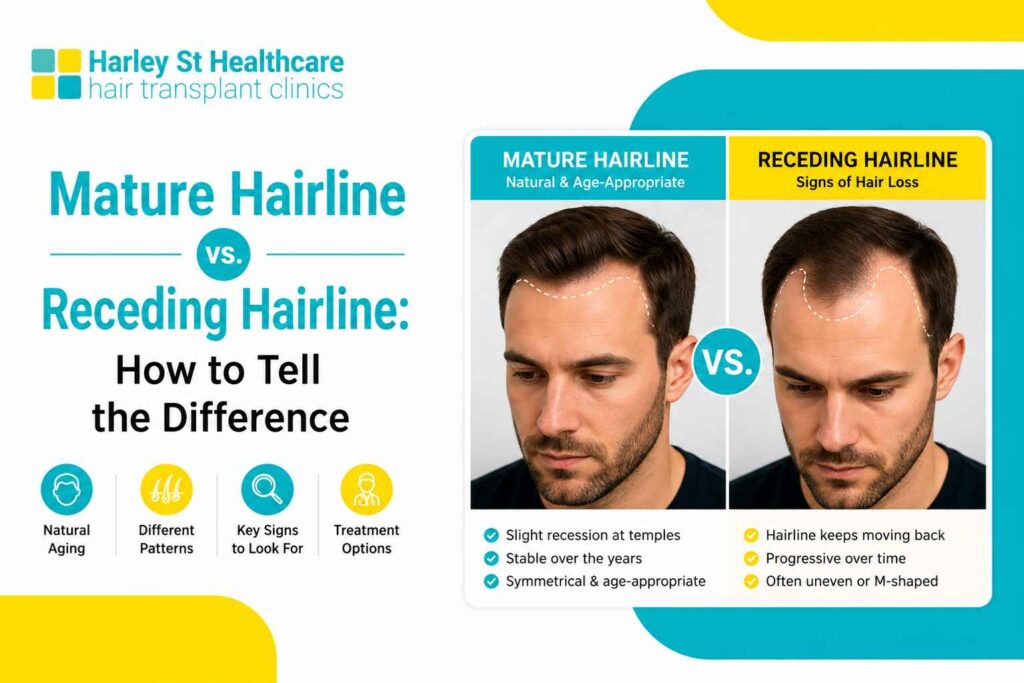
Noticed your hairline changing and wondering whether it’s a normal mature hairline or the start of hair loss? You’re not alone.
Many men begin to notice subtle changes around their temples in their late teens or twenties and immediately worry they are going bald. However, not every hairline change is a sign of male pattern baldness.
A mature hairline is a natural part of ageing and affects many men as they move from adolescence into adulthood. A receding hairline, on the other hand, is usually associated with progressive hair loss and may continue to worsen over time if left untreated. Understanding the difference between a mature hairline and a receding hairline can help you determine whether your hairline changes are normal or whether it’s time to consider treatment options.
Table of Content
ToggleWhat Is a Mature Hairline?
A mature hairline is the natural transition from a youthful or juvenile hairline to an adult hairline.
During childhood and adolescence, the hairline typically sits lower on the forehead with a relatively straight shape. As men enter their late teens and twenties, the hairline often moves slightly higher and develops a subtle M-shape around the temples.
This process is completely normal and does not necessarily indicate hair loss.
Characteristics of a Mature Hairline
- Slight recession at the temples
- Symmetrical appearance on both sides
- Hairline moves back approximately 1 to 2 cm
- Stable position over time
- No significant thinning behind the hairline
- Hair density remains strong
For many men, a mature hairline develops between the ages of 17 and 30 and then remains relatively unchanged for years.
What Is a Receding Hairline?
A receding hairline occurs when hair loss causes the hairline to gradually move further back across the scalp.
Unlike a mature hairline, recession is usually progressive and often linked to androgenetic alopecia, commonly known as male pattern baldness.
The recession typically begins at the temples and may continue towards the crown over time.
Characteristics of a Receding Hairline
- Deepening temple recession
- Uneven or asymmetrical hairline changes
- Thinning hair around the frontal scalp
- Continued movement of the hairline backwards
- Reduced hair density
- Family history of hair loss
Without treatment, a receding hairline can progress through various stages of hair loss.
Mature Hairline vs Receding Hairline: Key Differences
Feature | Mature Hairline | Receding Hairline |
Cause | Natural ageing process | Male pattern baldness |
Age | Common between 17-30 years | Can begin at any age |
Progression | Usually stabilises | Continues to worsen |
Temple Recession | Mild | Significant |
Hair Density | Remains strong | Often decreases |
Shape | Soft M-shape | Deep M-shape or V-shape |
Hair Thinning | Minimal | Common |
Treatment Required | Usually no | Often recommended |
The most important difference is progression. A mature hairline generally settles into a stable position, whereas a receding hairline continues moving backwards over time.
Mature Hairline vs Juvenile Hairline
Many men compare their current hairline to photos from their teenage years and assume they are losing hair.
In reality, the transition from a juvenile hairline to a mature hairline is entirely normal.
Juvenile Hairline
- Low and straight across the forehead
- Rounded corners
- Common during childhood and adolescence
Mature Hairline
- Slightly higher position
- Mild recession at temples
- More defined adult appearance
This shift does not necessarily mean you are balding.
How to Tell if Your Hairline Is Receding
If you’re asking, “How do I know if my hairline is receding?” there are several warning signs to look for.
Your Hairline Continues Moving Backwards
A mature hairline usually stabilises after developing. If you notice ongoing recession over several months or years, this may indicate hair loss.
Increased Hair Shedding
Finding excessive hair on your pillow, in the shower, or while styling your hair may suggest active hair loss.
Visible Thinning
Hair behind the hairline may begin to appear less dense, making the scalp more visible.
Deep Temple Recession
Significant recession around the temples often creates a pronounced M-shaped hairline associated with male pattern baldness.
Family History of Hair Loss
If close relatives experienced early hair loss, your chances of developing a receding hairline may be higher.
Mature Hairline at 20: Is It Normal?
Yes.
Many men develop a mature hairline in their late teens or early twenties.
A mature hairline at 20 is often part of normal development rather than a sign of balding.
However, if the recession continues rapidly or is accompanied by thinning, it may be worth seeking professional advice.
Stages of a Receding Hairline
Hairline recession is commonly assessed using the Norwood Scale.
Norwood Stage 1
Minimal or no recession.
Norwood Stage 2
Early temple recession begins.
Norwood Stage 3
More noticeable recession creating a deeper M-shape.
Norwood Stage 4 and Beyond
Hair loss progresses across the front and crown of the scalp.
Understanding where you fall on the Norwood Scale can help determine whether treatment may be beneficial.
Can a Mature Hairline Become a Receding Hairline?
Yes.
Having a mature hairline does not guarantee that hair loss won’t occur later.
Many men develop a mature hairline in their twenties and then begin experiencing male pattern baldness years later.
This is why monitoring changes over time is important.
If the hairline remains stable, it is likely mature. If recession continues, it may indicate active hair loss.
What Causes a Receding Hairline?
Several factors can contribute to hairline recession.
Genetics
Male pattern baldness is strongly influenced by family history.
DHT Sensitivity
Dihydrotestosterone (DHT) can shrink hair follicles and shorten the hair growth cycle.
Ageing
Hair naturally becomes finer and less dense with age.
Lifestyle Factors
Stress, poor nutrition, smoking, and certain medical conditions can contribute to hair thinning.
Treatment Options for a Receding Hairline
If your hairline is actively receding, several treatment options may help slow or reverse hair loss.
Minoxidil
Minoxidil can help stimulate hair growth and prolong the growth phase of the hair cycle.
Finasteride
Finasteride works by reducing DHT levels, helping to slow hair follicle miniaturisation.
Low-Level Laser Therapy
Laser devices may improve hair growth in some individuals.
Hair Transplant Surgery
For advanced hairline recession, a hair transplant can restore a natural-looking hairline using your own healthy donor hair.
When Is a Hair Transplant the Best Option?
A hair transplant may be suitable if:
- Hair loss has stabilised
- Medications are no longer providing sufficient improvement
- Significant recession has occurred
- Adequate donor hair is available
Modern FUE hair transplants can create natural-looking results that blend seamlessly with existing hair.
Why Choose Hair Transplant Clinics?
At Hair Transplant Clinics, we connect patients with trusted hair restoration specialists across the UK.
Our experts assess your hairline, hair loss pattern, donor area, and long-term goals to recommend the most suitable treatment options. Whether you need professional advice, non-surgical treatments, or a hair transplant, we’re here to help you make informed decisions about your hair restoration journey.
When Should You Seek Professional Advice?
You should consider a professional assessment if:
- Your hairline continues to move backwards
- Hair thinning is becoming more noticeable
- You have concerns about male pattern baldness
- You are considering treatment options
Early intervention often provides the best opportunity to preserve existing hair and slow future hair loss.
Conclusion
A mature hairline and a receding hairline may look similar at first, but they are very different.
A mature hairline is a normal part of ageing that usually stabilises over time, while a receding hairline is often an early sign of male pattern baldness and may continue to worsen without treatment.
If you’re unsure whether your hairline is maturing or receding, a professional assessment can provide clarity and help you explore the most appropriate treatment options if needed.
Frequently Asked Questions
A mature hairline is the natural movement of the hairline slightly higher on the forehead as men transition from adolescence into adulthood.
No. A mature hairline is a normal part of ageing and does not necessarily indicate hair loss.
Signs include ongoing recession, temple thinning, reduced density, and progressive movement of the hairline over time.
Yes. Some men develop a mature hairline first and later experience male pattern baldness.
Most mature hairlines develop between the ages of 17 and 30.
Depending on the cause and stage of hair loss, treatments such as Minoxidil, Finasteride, or hair transplant surgery may help restore hair growth.
Yes. Transplanted hair follicles are generally resistant to DHT and can provide long-lasting results.