Blog Summary
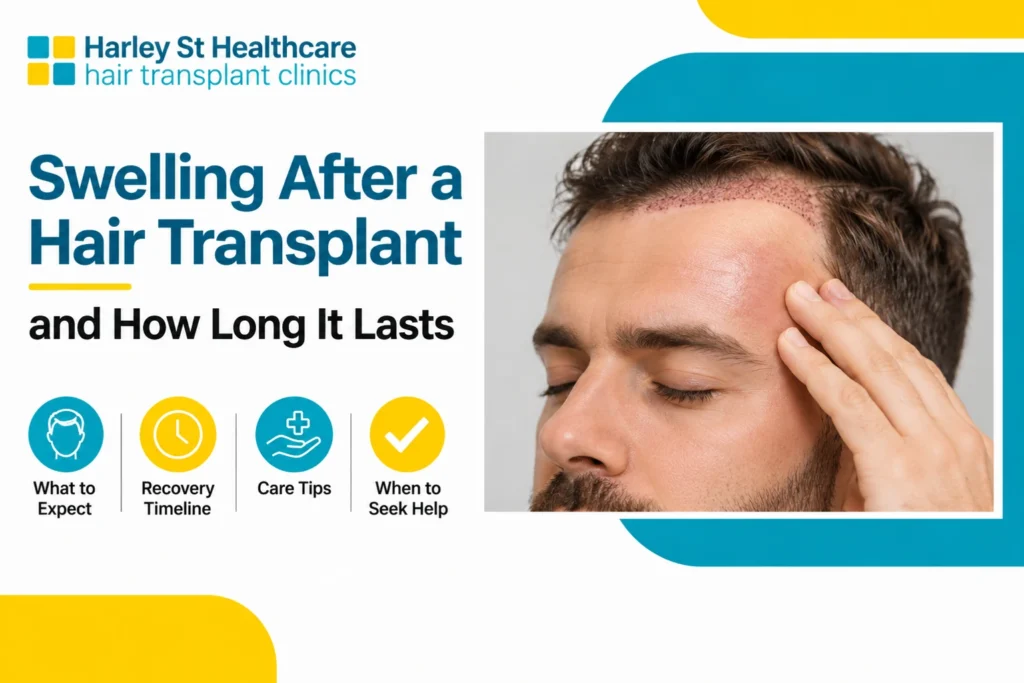
Swelling after a hair transplant is normal, and for most people it follows a predictable pattern. It usually appears on day 2 or 3, peaks around day 3 or 4 and settles by day 7 to 10. It starts on the forehead and, because of gravity, can drift down towards the eyelids. It looks alarming in the mirror, but it is soft, mostly painless and a normal part of healing.
Table of Content
ToggleThis guide explains what causes it, gives you a day by day timeline, shows how to keep it down and lists the signs that mean you should ring your clinic. It is general guidance only. Your surgeon’s aftercare instructions always come first.
Why the forehead swells after a hair transplant
A hair transplant is not one wound. It is hundreds or thousands of tiny ones, in the donor area where grafts are taken and in the recipient area where they are placed. Your surgeon also injects local anaesthetic to numb the scalp, which adds fluid to the tissue. Your body then does what it does after any surgery and sends blood and immune cells to the area, which brings inflammation and even more fluid.
That fluid cannot stay where it started. The skin on the forehead and around the eyes is loose, so fluid settles there easily, and gravity pulls it down over a couple of days. This is why swelling often shows up on day 2 or 3, even when you felt fine leaving the clinic. It is fluid moving downhill, not an injury to your face.
The NHS says a tight, achy and swollen scalp for a few days is common after a hair transplant, and that you may need one to two weeks off work. You can read the full NHS guidance on hair transplants for the wider picture.
How long does swelling last after a hair transplant?
For most people, swelling lasts between 7 and 10 days from the day of surgery. A smaller group have a little puffiness for up to two weeks. This is the usual pattern.
| When | What you will probably notice |
|---|---|
| Day of surgery and day 1 | The scalp feels tight. Little or no visible swelling yet. |
| Day 2 to 3 | Puffiness starts across the forehead and may reach the brows. |
| Day 3 to 4 | The usual peak. The forehead looks full and the eyelids may feel heavy or look puffy. |
| Day 5 to 7 | Fluid drains and swelling falls quickly. Many people look close to normal by the end of this stretch. |
| Day 7 to 10 | Most swelling has gone. A little morning puffiness is still common. |
| Up to day 14 | Occasional lingering puffiness, or fading bruising under the eyes. |
Research supports this timing. A 2010 study of 340 hair transplant patients in the Journal of Cutaneous and Aesthetic Surgery described forehead and eyelid swelling as a common result of surgery, especially two to six days after the operation. The researchers checked patients every day for six days for that reason.
Surgeons often grade swelling in four steps, which helps explain what you might see in the mirror.
- Grade 1 is swelling on the upper forehead only.
- Grade 2 reaches both the upper and lower forehead.
- Grade 3 spreads around the eyes.
- Grade 4 includes black eyes.
Plenty of people stay at grade 0 or 1 and never feel more than slight tightness. If you reach grade 3, you have not done anything wrong. Your own tissue, how much fluid was used during surgery and how closely you follow aftercare all play a part.
Swelling around the eyes and bruising
When swelling reaches the eyelids, it can be hard to open your eyes fully for a day or so around the peak. It looks worse than it feels, and in most cases it drains by itself as the fluid works its way out. If bruising appears, it will change colour from purple to green and yellow as it fades, like any other bruise.
Plan to stay at home through the peak days. Do not rub, press or massage your eyes or forehead. If your vision changes or your eyes become painful, call your clinic straight away.
Swelling after FUE, FUT, beard and eyebrow transplants
The pattern is similar across procedures, but the place you notice it changes.
With an FUE hair transplant, grafts are taken one by one without stitches, so most of the swelling comes from the recipient area at the front. The forehead and eyes are the usual places.
With FUT, a strip is taken from the back of the head and closed with stitches. You can get the same forehead swelling, and you may also feel tightness and mild swelling around the donor wound. Keep that wound clean and follow your wound care instructions closely.
After a beard transplant, swelling tends to sit in the cheeks, jawline and around the lips rather than on the forehead, and the skin is tender for a few days. Our post on beard transplant side effects and recovery covers that in detail.
Eyebrow grafts go in just above the eyes, so swelling tends to sit around the brow and upper eyelids and can look more noticeable. Our eyebrow transplant before and after guide shows what recovery looks like.
How to reduce swelling after a hair transplant
You cannot prevent swelling completely, but you can limit it and keep it away from your eyes. These steps are widely recommended by UK clinics. If your surgeon’s advice differs, follow your surgeon.
- Sleep with your head raised. Aim for roughly 30 to 45 degrees, using extra pillows, a wedge or a recliner, for the first few nights. A travel neck pillow stops you rolling sideways. Keeping your head up helps fluid drain away from the forehead and eyes.
- Use a cold compress only if your clinic allows it. Wrap a cold pack in a clean cloth and place it on the forehead above the brows, never on the grafts. Keep each session short and stop if the skin feels numb or uncomfortable.
- Drink plenty of water. Staying hydrated supports normal fluid drainage.
- Skip alcohol and smoking in the first days. Both can get in the way of healing, and alcohol can interact badly with some medication.
- Rest, with only gentle movement around the house. Heavy lifting, bending forward, hot showers, saunas and workouts push blood pressure up towards the head and can make swelling worse. Ask your clinic exactly how long to wait before each one.
- Take your medication as prescribed. Some surgeons add a steroid to the numbing solution or prescribe a short course afterwards. In the 2010 study, about 97 percent of the patients who had triamcinolone added to the numbing solution had no swelling in the first six days. That was a single study of strip surgery patients, so treat it as an interesting finding rather than a promise. Ask at your consultation how your surgeon manages swelling, and do not add your own anti-inflammatories or antihistamines without checking first.
- Do not touch the area. Pressing or massaging the forehead will not move the swelling along and can disturb grafts.
When swelling after a hair transplant is not normal
Normal swelling is soft, fairly even on both sides and gets better after the peak. Ring your clinic if you notice any of the following.
- Swelling is still clearly getting worse after day 5, or has not eased by day 10 to 14.
- The area is hot, red and spreading, or you see pus or yellow crusting.
- You have a fever or feel generally unwell.
- Pain is increasing instead of easing.
- The swelling is hard, lumpy or only on one side.
- Your vision changes or your eyes become painful.
The NHS advises contacting the clinic as soon as possible if you have severe pain or any unexpected symptoms. If you develop swelling of the lips, tongue or throat, trouble breathing or a sudden widespread rash, treat it as a possible allergic reaction and call 999. This is rare, but it is an emergency.
When can you go back to work with swelling?
The NHS says you may need one to two weeks off work after a hair transplant, and swelling is a big reason. If you work from home and your swelling is mild, you may manage a quiet few hours sooner. If you meet clients or colleagues face to face, it is sensible to wait until the swelling and scabbing have cleared. Days 3 and 4 are the worst for appearance, so avoid booking anything important then. Your surgeon can give you a realistic date once they have seen how your procedure went.
Does swelling affect your hair transplant results?
Normal swelling does not affect how many grafts grow, and it is not a sign that the transplant has failed. What protects your grafts is how you sleep, not touching the area and following aftercare. Infection is what can damage results, which is why the warning signs above matter.
Swelling is also separate from shedding. Many people see transplanted hairs fall out two to four weeks after surgery, which is normal and called shock loss. Our guide to shock loss after hair transplant surgery explains it. Most people see their final result at around 9 to 12 months.
Support during recovery at Harley St Healthcare
We have clinics in London, Manchester and Birmingham, and every patient starts with a free consultation. That is the right time to ask how swelling is managed, what the aftercare plan is and who to call if something worries you. Our clinics are registered with the Care Quality Commission and our surgeons are registered with the General Medical Council. Whichever clinic you choose, check both registers yourself before you book. We also arrange follow-up appointments after your procedure.
If you are planning a hair transplant and want to talk through recovery, book a free consultation or call 0207 030 3364. Our team is available from 9am to 9pm, seven days a week.
Swelling after hair transplant FAQs
Most swelling appears on day 2 or 3, peaks around day 3 or 4 and settles by day 7 to 10. Some people have mild puffiness for up to two weeks. If it is still getting worse after day 5 or has not eased by day 14, contact your clinic.
Yes. Fluid from the scalp and forehead drifts down with gravity and settles around the eyelids, where the skin is loose. It can make your eyes hard to open for a day or so around the peak. It usually drains by itself. Call your clinic if your vision changes or your eyes become painful.
Not completely, but you can reduce it. Sleep with your head raised, keep activity light, drink water, avoid alcohol and take your medication as prescribed. Ask your surgeon at the consultation how they manage swelling, because some add a steroid to the numbing solution.
Only if your surgeon has said so. Some medicines can affect bleeding or healing, so check before taking anything beyond the aftercare pack you were given. A pharmacist or your clinic can advise.
No. Swelling is the body's normal response to surgery and does not affect how many grafts grow. Signs of infection, such as heat, spreading redness, pus or fever, need prompt attention, but they are uncommon.